
“As a species, we’ve somehow survived large and small ice ages, genetic bottlenecks, plagues, world wars and all manner of natural disasters, but I sometimes wonder if we’ll ever survive our own ingenuity.” Diane Ackerman, poet, writing in the New York Times, 10 June 2012.
As a Millennial, and I am sure I am far from alone, the phrase ‘Stop Killer Robots’ initially conjures little more than half-baked university musings on the moral implications of artificial intelligence (AI), as well as a whole lot of Arnold Schwarzenegger.
Killer robots are a rather well-established literary and cinematographic trope, for good and for bad. Whether it’s the unflinchingly amoral bad-guy, or the android capable of a sometimes rather startling semblance of morality, it makes for a very useful philosophical actor to bend whichever way of the point you are trying to make, not to mention some truly epic films.
And yet, quietly and largely unaccounted for, here in the real world research into automated weapons and robotics marches on. According to the Campaign to Stop Killer Robots, some of the world’s largest military powers, including the US, the UK, China, Israel, Russia and South Korea, are known to be currently researching, developing and testing fully autonomous weapons.
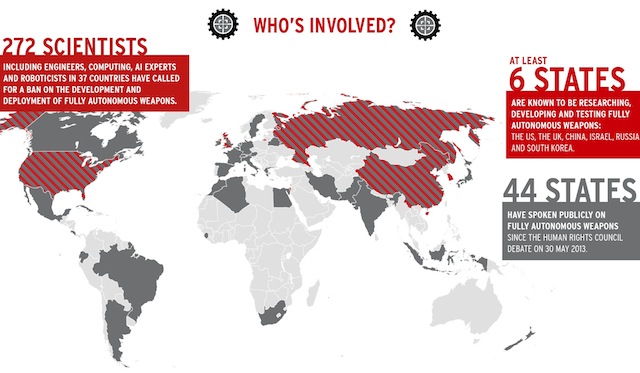
Infographic: Action on Armed Violence
Somehow the phrase ‘fully autonomous weapons’ fails to strike quite the same note as ‘killer robots’, but the two are largely synonymous, and are defined by the Campaign as robotic weapons capable of choosing and firing on targets independently, without the need for human intervention.
Now, though Terminator does save the day in the homonymous films, there is a big difference between an arguably cheesy, but otherwise safe, cinema experience and knowing that you might one day encounter his markedly un-literary and resolutely amoral cousin in real-life. There is something nastily incongruous about humans dying by the decision of an entity which requires assembling to exist.
Indeed, speaking to Reuters news agency last year, Noel Sharkey, professor of Artificial Intelligence and Robotics at the University of Sheffield, and a prominent member of the Campaign, said: “The idea of a robot being asked to exercise human judgment seems ridiculous to me.”
Adding: “The whole idea of robots in the battlefield muddies the waters of accountability from my perspective as a roboticist.
Accountability is paramount, precisely because as a species we are consciously striving towards making many acts of war illegal, and bringing their perpetrators to account.
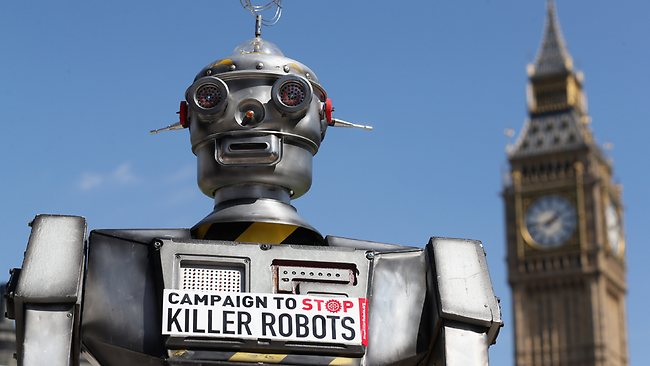
Image Source: Global Post
Introducing an instrument which can make the decision for us and take the fall for war, is a step back along the road to the goal of peace. As a dear friend of mine once said, ‘we have a duty to respect the seriousness of killing’.
The reason war is intrinsically abhorrent is the necessary violence against humans it entails, not only against the victims, but also for those tasked with making them such.
We could be tempted into hoping the introduction of such machines might eventually diminish the presence of humans of conflict, but for the knowledge that the purpose of these machines is and remains to harm human targets.
Even if that were to change, a threat to a country’s people is what makes it desist from war, or eventually bend to the will of the stronger threat. Every militarised superpower knows that damaged machines will never be able to exercise the same pressure on governments as harmed people.
Although we have good reason to congratulate ourselves on humanity’s progress, just because we can do something does not mean we should. Perhaps the greatest ingenuity in cases such as that of automated weapons lies in prescience, and recognising our responsibility to guard future generations from the unforeseeable consequences of today’s ideas.
Now, before it really is too late.
About the Author






[…] […]
[…] […]