
Our previous and current government have tried endlessly to find independent, scientific studies which prove that the War on Drugs is working, and that illegal drugs should remain illegal – yet time and time again, such commissions fail to give them the answer they are looking for. Such studies range from those produced by the Institute of Social and Economic Research, to the various studies by Professor David Nutt (a man who was shunned by the UK government for his values and views).
What we have in the UK is “punitive prohibition”, meaning that certain drugs are completely illegal to manufacture, sell and possess and such activity is punishable by a fine, community service or imprisonment. At first glance, the “War on Drugs” all sounds very noble; it is essentially the idea that you are fighting against illegal drugs, assuming (for the sake of argument) that illegal drugs are the “enemy” here.
But why are we imprisoning people who may be victims of this “enemy”, such as addicts?
It was their original choice to use drugs. And yet we do not throw alcoholics in prison, because it was their body and their decision. Of course, many would make the moral argument that drug addicts have committed a wrong in the first place because such substances are illegal – but in my view it should not be illegal to consume something, and people who have broken this law usually hold this view.
Activities which do not have directly harmful consequences on others should not be criminalised. More to the point, it is the case that in many countries, protesting against the government, for example is illegal. Does this make it wrong? I am not, of course, equating activism with drug use on any moral level, however this does somewhat disprove the argument that anyone should be criminalised not because there is logic behind criminalising them, but just because there are certain laws in place. Addicts, who have evidently made bad choices, should receive medical help, not face the full force of the criminal justice system.
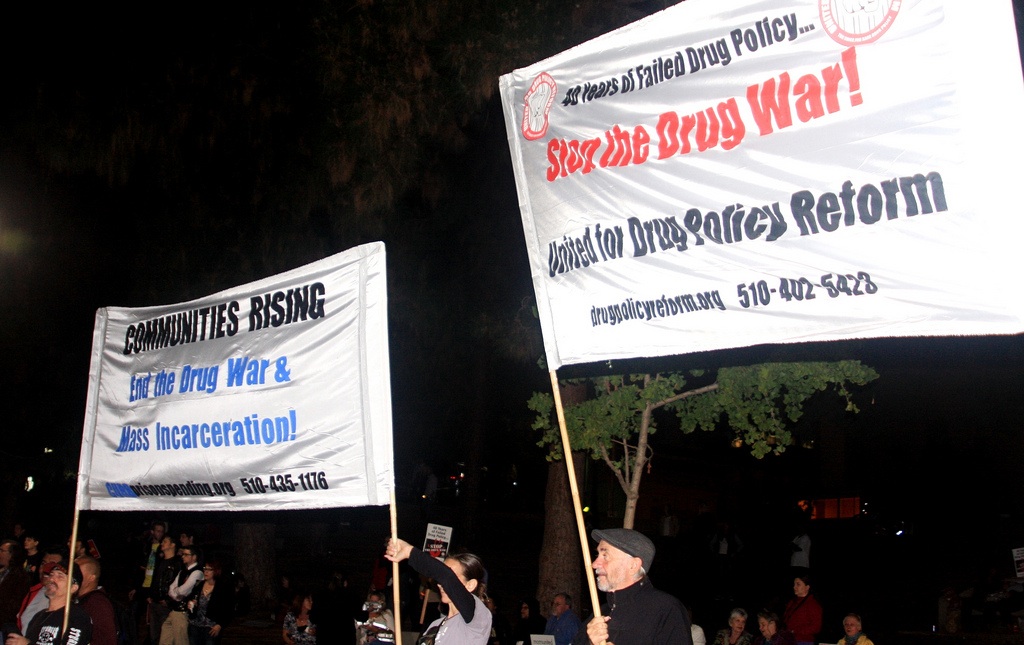
Rally & Concert to End the War on Drugs – MacArthur Park, Los Angeles. November 3, 2011. Image credit: Nikki David
It is equally as important to stress that there is another angle to this debate. Take, for instance, the thousands of people across the UK who use drugs but do not need medical help, because they only take drugs recreationally or occasionally. They are not addicts, the use of drugs is something which does not interfere with their lives. Doctors, students, lawyers, shop assistants, artists and others may consume marijuana, psychedelics or “party drugs” to unwind, just as many people have a glass of wine.
As demonstrated by a survey taken in 2011-12, 11.1% of the population of England and Wales (700,000 people) had taken an illegal drug in the last month, and 1.3 million (19.3%) had done so in the last year. With approximately 200,000 registered addicts in the UK, this leaves the rest as users who are not addicted and have no problems. In my view, such people do not need any government help or sympathy, simply because they are functioning members of society who do not need to be dealt with – but nor should they face legal consequences, since there is no victim of their “crime”.
Essentially, the War on Drugs is paradoxical, because if there is an addict – a victim of the “crime” of taking drugs – we should not be imprisoning them, for the reason that they are themselves the victim and need treatment. If there is no addict involved at all, there is no victim, therefore there should be no crime.
What would be a much more comprehensive solution would be to discourage people to abuse drugs in the first place by not glamorising drugs in film and social media, and by teaching young people proper lessons about drugs, just as we need to do with alcohol.
More importantly, the government must realise that by criminalising drug use, all the power and wealth goes to organised crime families and drug gangs, who often operate above the law because of the power and influence they wield. Consequently, most of the violence and the hardship caused by the drug culture is caused by the drugs’ illegality, giving drug dealers and organised criminals that power in the first place. The drug trade would not be controlled by these criminals if certain drugs were legalised and they lost their monopoly on the trade.
It is very unlikely that legalising and taxing softer drugs such as marijuana would lead to a usage increase, as proven by places where this has been done, and legalisation would also ensure that usage was regulated. The possession of other drugs and the sale of drugs to healthy, non-addicts should be decriminalised, which would ensure that taxpayer’s money and police time are not wasted on arresting the wrong type of people and keeping them in prison for years. All those party drug enthusiasts, for example, who are only guilty of being reckless and irresponsible if anything else, along with the 19-year-olds, for instance, who have been caught with a few tabs of LSD on them.
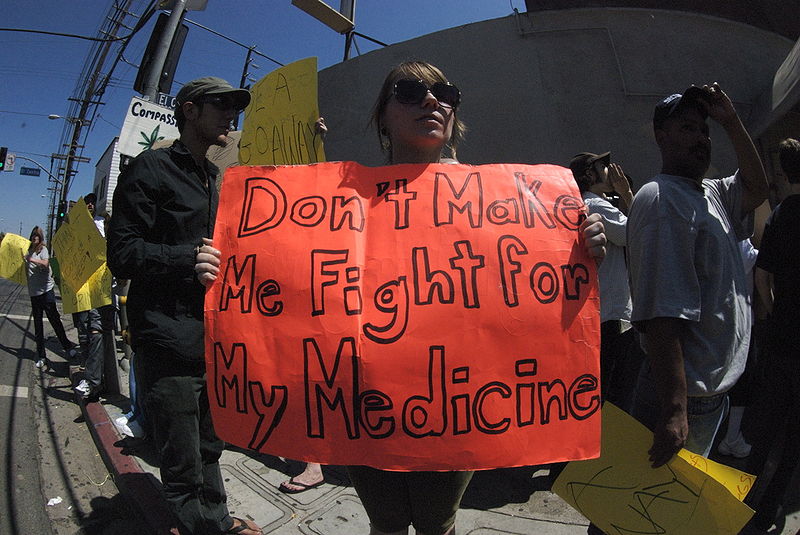
DEA raid on a medical marijuana dispensary in Hollywood, California. Image credit: shay sowden
We need an intelligent drugs policy – one which trusts the scientific studies (rather than traditional scaremongering), makes distinctions between addicts and non-addicts and between types of drugs, and which assesses cases individually, based on who the victim of the situation is, giving anyone who is suffering from a drug addiction proper treatment, rather than throwing them in prison. The organisation Students for Sensible Drug Policy (SSDP) are among those across the younger demographic who support a coherent, common-sense based strategy to replace the War on Drugs.
About the Author





