
I was sent on assignment by my editor to head to the Rwanda High Commission to cover the Genocide Commemoration. This was the second time I would be attending such an event. The first was in 2011.
I must say, I grew up with the picture of Rwanda being synonymous with the 1994 genocide, death and refugees. And in most occasions, when I met a Rwandan, my first question would be: Were you there during the genocide? How old were you then? Is it any better now?
Looking at it now, I can’t help but see how insensitive my questions have been. But, I hadn’t realized how callous they were until two days ago, the 14th of April. I was attending the 20th commemoration of the genocide and I was in the midst of people whose relatives had been killed during the genocide. I realized that my three questions: Were you there during the genocide? How old were you then? Is it any better now? while innocent, simply stirred emotions that prompted tears, sad memories and pain.
This is because, twenty years later, tears and emotions were fresh and ran high as names of relatives and friends killed during the genocide were mentioned. Already after the first 100 names were called out…Pierre…Marie…Esperanza…Solange… almost all eyes in the the crowd were glazed. People were blowing their noses, handkerchiefs tightly held around mouths and some people, in fact a lady next to me, was shaking and sobbing. A young man across to where I was, was as if in hiding, drying the sides of his eyes while comforting a lady, who I suspected was either an elder sister or an aunt.
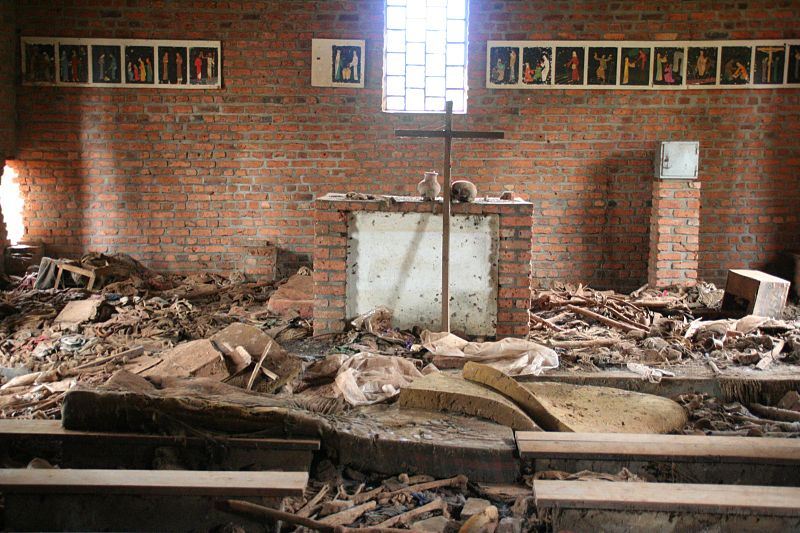
5,000 people seeking refuge in this church were killed by grenade, machete, rifle and burning alive. Most of it has been moved into another building, but among the pews remains jawbones, leg bones, childrens shoes, hairpicks, scarves and more. Image credit: Scott Chacon
Two decades on and the pain still stung. Their pain was alive, breathing and evident. You could feel it in the air, it touched you, went down your spine and jabbed on your eyes. It catalyzed something in you. It made you weak. It made you weep.
I held at a thorny white rose given to me at the beginning of the memorial service and its thorns brought me back to the gathering. It hit me that beautiful, promising lives had been nipped down, chopped away by a welding machete, destroyed by bullets…innocent lives of Tutsis were no more. About a million lives. That left behind broken families, destitute children and the dead among the living. They left behind scars that time, even twenty years later, would not heal.
I talked to one lady, who only gave me her one name: Theresa. She said she was afraid of people from the press. I understood. We get that a lot. Theresa was probably in her late forties but as we talked, the events that happened almost two decades ago were freshly etched in her mind. Actually, they were stamped there, painfully so. She looked at me, reached out her hand to mine and said:
I walked with her for a while after the event and her thoughts kept playing in my head.
Smell of death.
Blood flowing.
The closest I have been to her description of events during the 100 days blood bath that left over 800,000 dead was in books. Just pages. Of course, not with Theresa’s description. It hit me, for a second time, that while I had been quick to prod about the genocide from anyone who says they are from Rwanda, either by birth or by visiting the memorial parks, I kept poking at wounds which had not healed. I was not sympathizing with them. No. I was hurting them with my arrogance and little understanding of what the genocide did to them.
The theme for this year’s commemoration was “Kwibuka 20: remember-unite-renew.” And, as I joined them to mark the 20th anniversary, as I helped lay the wreath to remember the lives lost, something sparked in me. That while people still equate Rwanda to the genocide, her people are soldering on. They were renewing their hope, they are moving away from their past and into a new future. However, as Theresa put it, “But to date, I have never forgotten the sight of blood flowing on the roads. Neither have I forgotten the smell of death.” Their pain still exists. Their wounds may be covered in a scab but each day, each April for a hundred days, the blood of their relatives still flows.
About the Author






An interesting read…I hope that the pain and hurt will reduce since it never really does go away.