
From the heart of North Yorkshire, a dark plume of smoke rises to the sky. The black stele comes from the chimneys of Drax Power Station, which burns more coal than any other power plant in Britain, and more wood than any other plant in the world.
Drax has converted one of its six units to run on wood pellets, and now burns through pellets made from five million tonnes of fresh wood per year. This form of electricity production cannot be considered “renewable”. Ironically, it is. Wood power stations are key to achieve EU and UK renewable energy targets by 2020; wood from any source is treated as “low carbon” by EU rules, which allows coal plants like Drax to claim they have reduced their emissions, turning into biomass electricity producers. Is this the kind of renewable energy we want?
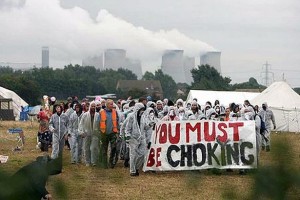
Protesters outside Drax Power Station. Image Source: http://bit.ly/1Ec8OpS
The EU’s Renewable energy directive sets a target of 20% final energy consumption from renewable sources by 2020. EU countries have committed to achieving their own national renewable energy targets. UK’s aim is to achieve 15% of final energy consumption from renewable sources. However, Britain is the third lowest producer of renewable energy in the EU, and is far below its sustainable energy targets for 2020. A report published by the Eurostat, indicates that the UK generates the third least renewable energy with just 4.2 per cent of its energy derived from green sources.
The Keep On Track 2014 report points out UK as one of the members not expected to achieve the targets. On the other hand, the Department of Energy and Climate Change (DECC) says the Government has “clear plans” in place to meet UK targets and that is committed to cost-effective renewable energy as part of a balanced, secure and low-carbon energy mix.
What are the plans?
DECC indicates that the 15% renewable energy is feasible with the following proportion of energy consumption in each sector coming from renewables:
- 30% of electricity demand;
- 12% of heat demand;
- 10% of transport demand.
The UK renewable energy policy framework is made up of three key components:
- Financial support for renewables;
- £30bn had been invested in renewable energy since 2010. The DECC has been apportioned £40 million in funds between now and 2020 to help bolster green energy production.
- Unblocking barriers to delivery; and
- Developing emerging technologies
- Based on eight technologies: onshore and off shore wind, marine energy, biomass electricity and heat, ground source and air source heat pump, and renewable transport.
Government figures show that 35 gigawatts of renewable capacity – mainly wind, solar, and wood-burning biomass – is already built, under construction or has planning consent. Nowadays, there are about 24 offshore wind projects and 1,200 turbines, plus 4,900 onshore turbines (702 wind projects), which power more than 7 million homes. Solar power almost doubled by the end of 2014. There were almost five gigawatts of solar photovoltaic panels installed, up from 2.8GW at the end of 2013. The solar industry said there were now enough panels installed in the UK to supply the equivalent of 1.5 million homes. Ministers believe biomass technology could provide as much as 11% of the UK’s energy by 2020, helping to meet its commitments. The Environment Agency estimates that biomass-fired electricity generation can cut greenhouse gas emissions by up to 90%. Eight biomass power stations are operating in the UK and a further seven are in the agenda.
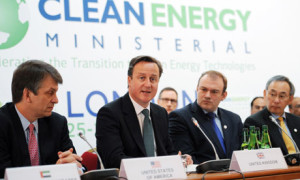
Leaked documents reveal UK’s fight to dilute EU’s green energy targets. Image Source: http://bit.ly/1Ec9rzV
Although the plan seems clear and the numbers are remarkable, there are two challenges that lie ahead beside the UK lag. First, the cost of renewable energy. Currently, this is the debate among parliament members. Ministers have said they are happy to use low-carbon technologies if they offer a cheaper route to decarbonising, which is the case of biomass technology but not of wind and solar. Recently, Prime Minister David Cameron declared that subsidies for wind would soon end. Maybe this is the reason behind the UK lag.
UK is at about 5.2% of final consumption from renewables, which means it needs to treble that figure in the next five years to reach the target, which seems unlikely within the current political scenario. Achieving the target through wind power alone would require an extra 50GW of offshore wind, in addition to the existing 10.5GW of capacity. Solar power looks unlikely to be the answer, in that UK would need an extra 42 million homes to be fitted with solar panels by 2020 (12 million of these houses are not yet built). Both options are expensive to the eyes of the parliament, and the cheaper option, Biomass, would call for an additional 40GW of generating capacity – the equivalent of another 11 Drax power stations all running on biomass, which is the second challenge. Biomass is very controversial for being considered by many activists as a one-way form to tearing down forests to feed power stations, therefore a wrong way to generate energy. Is the UK going to apply a Machiavellian attitude in order to achieve the EU targets?
Meanwhile, the government says that it has already approved enough renewable energy projects to hit its targets, estimating that will be more than enough to achieve 15% of energy from renewable sources by 2020. The government’s decision over the next few years will be critical not only to meet the 2020 targets but also to define the means to do so.
About the Author





