
Since the 1979 Islamic Revolution, few countries have challenged Iran’s ‘international villain’ status. The United States is the loudest champion of this animosity and mutually demonizing rhetoric. The word ‘Demonising’ is accurate in describing the language of US-Iran relations: axis of evil and the great satan is an example of this ongoing war of words. Now, however, there is little sign of animosity and nothing but smiles at the so-called nuclear talks between Iran and The 5+1. This spectacular shift in rhetoric and the quasi-regular US Iran official meetings shows just how intricate the relationship is. The Iranian and American regimes are fantastically similar and their tendency towards reconciliation does not come as a surprise.
Banal similarities, like the set-up of their foreign ministry press room (a globe resting on a blue background), take roots deeper in their institutions and state philosophies.
Both rely on an elaborate fragmentation of power, not only between the three branches of government, but also within the judiciary, executive and legislative. Higher and essentially unelected councils on defence and other strategic matters are a default feature. Both regimes operate democratic elements especially through presidential and parliamentary elections. Both their elites (in this league being a cleric and/or CEO both yield membership rights) and influential circles mistrust popular tendencies. The stability of the regime is strongly protected and guarded against it.
In Fact their two-party system guarantees that party pluralism never spirals out of the regime’s essential tenants.
Political agendas are regulated and tamed within these political cadres. Any seriously emerging “third way” or party is always radically reprehended (Exp: The green movement of Iran, Communism -40’s and 50’s- or Occupy America). This two party (or de facto two-party-only) system allows both for stability and acclimation to changing affairs both at home and abroad. A conservative Ahmadinejad era disenfranchised parts of Iranian society and risked estranging them from the regime all together. The “green revolution” of 2009/2010, especially in Tehran, showed how critical this discontent has become. The regime, after crushing the rebellion, allowed then for a reformist president, Rouhani, to circumvent that anger and safely funnel it. Similarly, Ahmadinejad abroad confrontational attitude was costing Iran increasing isolation that it was eager to break with.
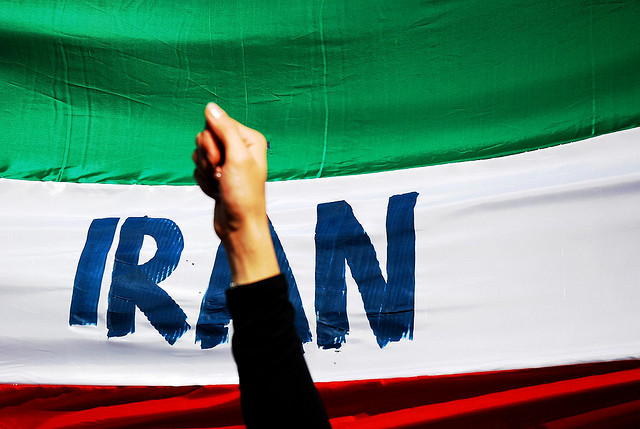
Photo courtesy of Kappazeta © 2009. Some rights reserved.
“Staging” Rohani’s (an establishment soft-reformist) ascendency was the answer of the regime to the question posed by the green movement. Rouhani was the only reformist contender against the conservative candidates. This guaranteed that the seemingly minority reformist votes would unite in favour of Rouhani and add the independent vote, where it thus became only logical for him to win from the first round. Meanwhile, the conservative vote was conveniently shared between many candidates. In Iran supreme institutions control the list of allowed candidates and it is obvious they also had a clear idea who would win these elections. The presidential election that pitted Rouhani against other mostly-conservative candidates was a smooth transition that again guaranteed stability and continuation. It is utterly mind boggling that international media outlets still insisted that Rouhani winning the presidential bid is “a surprise”.
Initial negotiations with the US started while Ahmadinejad was still in office. Before Rouhani assumed office, the new stance towards the US was already decided by the regime’s powerful “supreme” institutions.
The Iranian regime is less mature and stable than that of the US’. Still it impeccably withstood international blockade and cold/real warfare, coming out largely unscratched from the nuclear talks. The US has not suffered any grave political turmoil or change since its civil war that ended in 1865.
But above all, striking US-Iran similarities consist of their claims of being “special nations”. This fundamental philosophical tenet is the underlying raison d’etre and ultimate rationale for the “peculiar” ways Iran and the US interfere and relate to their allies and foes alike. In the case of Iran, the Persian racial component is coupled with Shiite evangelism (in a bundle served, among ather elements, as the Islamic Revolution). The US considers itself the heart and protector of “the free world”, champion of democracy and what it calls “world peace”.
Both regimes function as proponents of higher moral codes and consider themselves historically and globally central forces endowed with exclusive noble missions. At the altar of these self-centred views of the world and humanity, Iran and the US do not mind -temporarily- sacrificing traditional moral imperatives in service of what they deem higher causes (i.e. supporting the tyrant Assad and Guantanamo-prison respectively).
In Iran, up to the highest echelons of government referred to the US as “the greatest Satin”. Former President of the US, Bush, solidly classified Iran as a member of “the axis of evil”. Now, with the Iran talks at full swing that seems a distant history. It is short sighted to attribute strategical tendencies of the US or Iran solely to the result of elections here or there.
The media hostility is nothing more than another arena to skirmish and showcase power and negotiation cards. A long term agreement is more probable and consistent with their interests. As the two powers found it impossible to bypass the other’s influence and as the US becomes increasingly wary of its middle east involvement (and builds up towards oil/gas self sufficiency) Iran is there filling up some of the regional power vacuums.
Incontestably, the US is the more powerful party while Iran enjoys regional power status. Naturally, the shift in the relationship from hostility to accord cannot be unfavourable to the US. Meanwhile, Iran is happy swallowing up problematic roles that the US is happier to delegate, in unstable countries such as Iraq and Afghanistan. All whilst appeasing and taming the sometimes troublesome and surely aspiring and ideologically-motivated Iran.
However claims that he US lost terrain to Iran in the middle east are erroneous. The US actually ensured that middle eastern powers are perpetually entrapped in the ultra-sophisticated internal affairs and entanglements of the middle east. The post-occupation woes of Iraq and Afghanistan exasperate an already volatile situation. The rise of ISIS insurgency in Iraq reminds of the chaos and civil wars of post colonial African nations. While this storm may blow off, the stern reality of ethnic and sectarian hatred will haunt the region, most notably Iran. The present nuclear talks reflects the new status quo that Iran and the US hope to consolidate.
Author’s Note: Most commentators oversimplify the nuclear talks. It is often said that they fall within the quest of the Obama administration to score a monumental foreign-affairs achievement by pacifying Iran. Or that “opening Iran” reflects the interests of multinational corporations undoubtedly eager for opportunities in oil-rich Iranian economy. That does not come close to explaining the handshake extending across from “Utmost Satan” to the “Axis of evil”. There is a deeper -imperial proportioned- love/hate story behind Vienna’s nuclear flirting.
About the Author





