
A drone attack in Yemen has left four al-Qaeda suspects dead, amid increased fears of a terrorist attack in the Middle East. It follows a global travel warning from the US on 2 August, and a closure of 20 embassies and consulates in the Middle East and Africa on Sunday.
It was reported that a number of terror group al-Qaeda’s members had crossed into Yemen, and were planning a coordinated attack along with a local cell against both Yemeni military bases and Western ambassadors and embassies. The security threat level of the country has been increased to “extremely high”, and US citizens have been urged to leave, with ambassadorial personnel being evacuated.
The New York Times reported that communications were intercepted between Ayman al-Zawahiri, a top al-Qaeda leader, and the head of the Yemen cell, Nasser al-Wuhayshi, leading to the strikes early today. Interpol warned that it connected with al-Qaeda linked jail breaks in nine countries recently.
Yemen has been a crucial sore in the body politic of international terrorism. The Yemeni branch of al-Qaeda is said to be one of the most militant of AQAP (al-Qaeda in the Arabian Peninsula). It has been blamed for the foiled Christmas bombing plot on an airliner over Detroit in 2009.
The US offers $23,000 to anyone with information on the group, and works with the Yemeni military and government to prevent a growth in terrorism. Yemen also shares a long border with US ally and top-oil exporter Saudi Arabia.
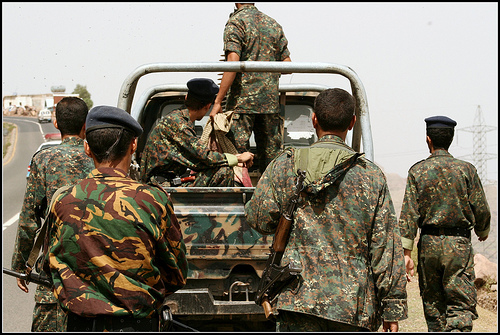
Reports from Yemeni capital Sana’a describe large-scale security measures, with armoured vehicles and military personnel in the city. Yemen’s spokesperson in Washington D.C, Mohammed Albasha, tweeted that “Yemen has taken these threats seriously and had taken all necessary measures to protect all the foreign missions”, in an effort to play down the crisis situation and provide a reassuring message of control.
Related: Drones: A Terror in the Sky
However, Yemeni organisations at a grass-root level have shown a long-term commitment to counter terrorism prior to this. A youth group formed the Ibdaa Shabab (Creative Youth) organisation in 2012, training 102 members in counter-terrorism by December of that same year. Its purpose is to raise awareness in schools in Sana’a of terrorism and guidance for students so that they might protect themselves against dangers.
This stems largely from al-Qaeda’s focus on recruiting from the student youth population, who are seen as most susceptible to their propaganda. The Ibdaa Shabab teacher’s seek to build “a generation of [Yemenis] who are aware, pious and steeped in Islam, which is based on centrism and moderation, so as to stand up to any conspiracy or sedition the country faces”. The statement mirrors the promotion of national loyalty outlined in their goals.
Arguably, therefore, Yemen would appear to have the current situation under control, or at least, would purport to. Perhaps it has suffered from the ever-increasing hype surrounding terrorism and the Middle East from the US and the west. It appears, therefore, that Yemen is a nation committed to countering terrorism, a commitment that has escaped mention in many leading newspapers today.
This article was originally published on the Urban Times.
About the Author





