
Afghanistan is facing a dramatic election crisis which threatens to tear the country apart. Although nearly 7m Afghan citizens turned up to vote, the results were dismissed by candidate Abdullah Abdullah, who alleged they had been tarnished by “industrial-scale” fraud and corruption.
The prevalence of corruption in Afghanistan is well known. The country lies at the very bottom of Transparency International’s Corruption Perceptions index, receiving just eight out of a possible 100 points. Corruption has become “part of the political dynamic of the country” argues Mark Pyman, Director of the Defence and Security Programme at Transparency International UK. In 2013, a former commander of the International Security Assistance Force described corruption as “the existential, strategic threat to Afghanistan”.
The US has been praised for its attempts to find a solution to the election crisis, with Barack Obama threatening to stop all American military and financial aid if Abdullah Abdullah did not back down, and John Kerry playing a key role in brokering a deal.
However, these early attempts to resolve the crisis through an ambitious election audit have been halted almost immediately after they began, with distrust and anger between political factions marring attempts to find a solution.
Moreover, the role of the U.S government in triggering this situation in the first place been less publicised. However, a new report released by the Pentagon demonstrates how the USA “created an environment that fostered corruption” through its support for warlords, private trucking contracts and the supply of aid money, in many ways creating the crisis that Afghanistan finds itself in today.
Warlords
The report finds that the American focus on defeating the Taliban created mutually dependent relationships between US. Forces and the warlords. The U.S. used the warlords of the Northern Alliance as a proxy force, providing them with support and patronage. This allowed them to “operate with impunity and improve their political positions” and has had long-lasting effects.
The report documents how President Karzai increased the power of the warlords, placing them in key government positions in order to secure his power base. Once in power the “warlords-cum-ministers” used their positions to divert resources to their constituencies, creating “criminal patronage networks” which became entrenched in the state.
Private contracts
The report also criticises US. dependence on contracting, arguing that the private security companies hired by local trucking companies were typically “warlords, strongmen, commanders and militia leaders” who compete with the Afghani government for power and authority.
These groups were paid protection money by the USA; in 2010, the U.S. gave $2.16 billion to eight trucking companies. This, the report demonstrates, provided warlords with “money, legitimacy and a raison d’etre for their private armies”, and undercut efforts to establish confidence in a “credible and sustainable” Afghan government.
U.S. commanders did not realise the impact of this situation until the networks were entrenched, and “any imposed sanctions would have significantly impeded U.S. logistics,” the report said.
Spending
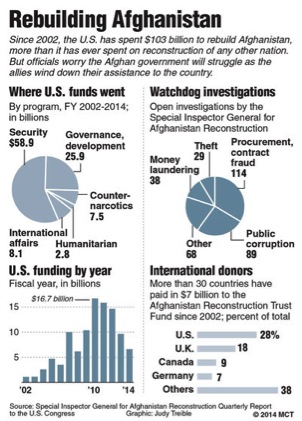
As the infographic above demonstrates, the U.S. Congress has appropriated $103 billion for Afghanistan reconstruction since 2002, including $64 billion since 2010. However, the report finds that the amount of military and aid money flowing into Afghanistan overwhelmed the economy, and created “ample opportunities for corruption”.
The government’s institutions were unable to handle such large sums of money, and “lacked the ability to account for their spending”. One US defence analyst argued that the international community as a whole poured money into Afghanistan with “an almost total lack of transparency” and no meaningful measures to combat corruption or waste. As one former commander described, “we never really understood the problem…we were naïve.”
A lasting impact?
The impact of these events on the future stability of the country is likely to be severe, with corruption threatening the “viability and legitimacy of the Afghan state” due to a “large-scale culture of impunity”, the Pentagon report argued.
A 2011 Transparency International report demonstrated that there is huge amounts of public anger against corruption in Afghan society, which could be used as a force for change.
However, in order for change to be possible, dramatic reforms need to be implemented. Both the Afghan government and the international community need to put the fight against corruption at the forefront of their agenda, or risk jeopardising the reconstruction effort altogether. While attempts by American politicians to help Afghanistan reach a workable solution to the current crisis may be welcomed, the corrosive role that the US has played in shaping the crisis should not be forgotten.
About the Author





