
The leader of UKIP, the UK’s increasingly popular independence party Nigel Farage announced after the Rochester by-election last week that, in the wake of his party’s victory, “all bets were off’ for the general election. What other developments do the Rochester & Strood by-election and Mark Reckless‘s victory hint at?
Labour were the real losers, despite having a very promising and able candidate in Naushabah Khan. This was largely because of a failure to control the story of Emily Thornberry’s controversial tweet. Rather than moving on, the party is still mired in a debate about its attitudes to the working classes, and the Conservative‘s embarrassing defeat has been forgotten. More and more, press and media reactions are driving the agenda. This phenomenon is of course not new; with The Sun’s infamous 1992 headline with Neil Kinnock; Gordon Brown‘s dismal reception in Britain’s press – but Ed Miliband‘s endless roasting both on social and mainstream media, which Farage is successfully managing to his and his party’s advantage, show just how important its effects are. The media is increasingly deciding what matters – immigration or a tweet or a resignation. And, as politicians strive to engage, using social media to become more relatable and accessible, which is just how Farage has managed to come across, they’d better beware. As Emily Thornberry learnt too late.
Meanwhile, the Green Party did very well indeed with their share of the vote increasing 250%, from 734 to 1,692 and finishing fourth. It’s clear this is a trend that looks set to continue – the Green Party is growing by almost 1000 new members a week. Are they becoming the new party for disillusioned left-wing voters, who are put off the Liberal Democrats?
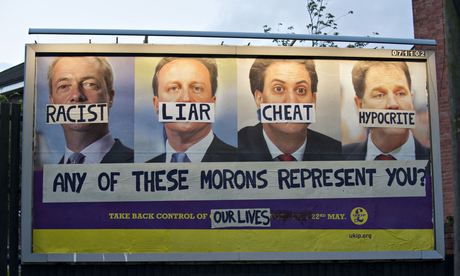
A vandalised UKIP billboard in Nottingham. Image Source: The Guardian / Tim Goode / PA http://www.theguardian.com/politics/2014/may/09/local-elections-potholes-parking-ukip-parties
In Rochester & Strood, the Lib Dems couldn’t even secure 1% of the vote. They are, along with UKIP, one of the next biggest parties, and as political alienation continues to grow, they will certainly be a candidate for protest (and more considered) votes. The Greens even have an unlikely ally in UKIP; UKIP councillor Paul Irwin told me that in Rochester, the Greens offer an alternative, they “have a voice”, and should certainly be included in the BBC electoral debates, as their relevance and influence hopefully looks set to increase as UKIP’s is.
This trend means that three-party politics is fast becoming a thing of the past, as more people search for an alternative to the Tories/Lib Dem/ Labour. Certainly there are few voters and supporters as vocal and energised as UKIP’s. They were the only real presence on the streets of Rochester on the day of the by-election, proudly wearing purple, and this level of optimism and belief in politics is a good thing. It might be a welcome side-effect of multi-party politics as younger parties bring their energy and momentum to challenge the mainstream ones. Even as UKIP are gaining seats, the Greens are also winning votes. It looks likely that coalition politics is here to stay, certainly in the next election, and Greens and UKIP are catching up with the beleaguered Lib Dems. Does this mean the Alternative Vote system, or indeed, proportional voting is the way forward? The main argument in favour of the ‘first past the post’ system is that it provides stable and secure government, but if we are likely to have many more coalitions and hung parliaments then a more proportional, fairer alternative system is viable again.
Lastly, the by-election result was a warning to Milliband and Cameron not to play to UKIP’s game. The majority with which Reckless won his seat was much less than expected, so before jumping to join Farage’s bandwagon by hastily announcing tougher immigration policies, stop to consider that this was a protest vote. Whether you find UKIP’s policy ideas convincing or not, they’ve successfully managed to paint themselves as the only real alternative, challenging the three main parties, increasing hard to distinguish from each other. The fact that Farage is not any different in practice is not the point. People are, rightly, disillusioned and frustrated by the state of Westminster at the moment and seeking an alternative with either UKIP, the Green Party, or, as Russell Brand suggests, withdrawing from the voting process entirely. People want to express their disappointment, want a change, and if the main parties let Farage set the agenda this won’t happen.
So, Messrs. Cameron, Clegg, and Miliband, don’t fight them on the beaches (at Dover) on immigration, fight them on the economy; fight them on their climate change scepticism; their attitude to women in employment. Change the arguments, stop relying on the tired roundabout of explanations and excuses, and, as Natalie Bennett’s Green Party is trying to do, set yourselves apart from each other, offer real choice, and help start to slowly reinvigorate your electorate and the political process. Hopefully this will mean that come the election next year the headlines are no longer full of obfuscations, similarities, and lazy thinking, but real, and energetic debate about change that we can all invest in.
About the Author






[…] http://archive.the-ipf.com/what-can-we-learn-from-the-rochester-by-election/ […]