
Last week the House is voted on the Nutrition Reform and Work Opportunity Act, a food stamp bill that would cut $39 billion from the Supplemental Nutrition Assistance Program over the next 10 years. Although this is about a 5 percent reduction in the size of the SNAP program, between 4 and 6 million of the current 49 million enrolled will lose their benefits. The food stamp program hasn’t seen significant reform or changes since the 1970s, and major changes need to be made to this program (and our budget). But, this doesn’t necessarily mean that the Nutrition Reform and Work Opportunity Act is the solution. Here are the changes that really should be made to America’s food stamp program:
Establish a Work Requirement with Adequate Resources to Aid Job Seekers
The Nutrition Reform and Work Opportunity act includes a new measure that would forbid states from waiving existing work requirements for able-bodied adults without dependents. Nearly 4 million able-bodied adults without dependents currently receive SNAP benefits, and these people represent about 60% of those who would lose their food assistance in this proposal. This is a sensible proposal, as many of these people need to work in the first place whilst helping them to move away from the assistance. However, according to analysis from the Center on Budget and Policy Priorities, states would not be required to offer jobs and/or job training and the current proposal doesn’t stipulate for any funds or resources to help current SNAP recipients to meet this requirement.
According to a survey from CareerBuilder, 35% of employers have been struggling to fill a position for 12 weeks or more. This same survey also says that many job sectors are poised for growth, even as companies struggle to fill current open positions. These sectors include sales, assembly, nursing, truck driving, accounting, and IT, and aren’t necessarily jobs that require college degrees or unique skill sets. People to fill these positions can easily be found on the rolls of food stamps, and if we’re going to establish a work requirement, then there should be a requirement for states to offer jobs and/or job training if there is going to be a work requirement, or added funds and resources for these requirements. It would help companies as well as those currently receiving benefits.
No Additional Restrictions on Purchases
Rep. Phil Roe, M.D. (R-TN) introduced H.R. 3073, the Healthy Food Choices Act last week into committee. The Healthy Food Choices Act would update the food guidelines for SNAP to bring them in line with the purchasing standards for the Women, Infants and Children (WIC) program. This legislation supposes that poor people i.e food stamp recipients spend their benefits on unhealthy food, and do so at a much higher rate than those who don’t receive benefits. The Christian Science Monitor survey reveals that spending habits of poor people and the rich aren’t are all that different.
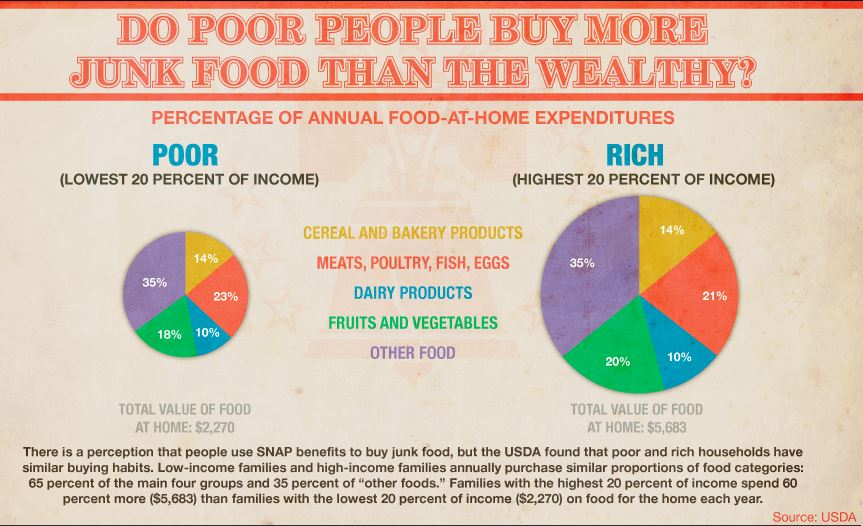
Food Stamp Infographic. Image credit: Christian Science Monitor
All this legislation would do is place additional, unnecessary restrictions on where these benefits can be spent when there are already prohibitions on alcohol, hot food or food eaten in the store, and many fast food restaurants. Although the standards in the WIC program are great standards, and ought to be followed, it takes out many cheap options, particularly frozen meals and other food products that can be made quickly and can easily feed a family of three of four a filling meal. These standards also limit the sizes that can be purchased, requiring a family of four to purchase only 36 ounces of cereal at time. This is the equivalent of two 16-ounce boxes, or three 12-ounce boxes. This means that this family, according to the WIC standards, has to purchase multiple boxes to reach the maximum and can’t purchase one or two bulk-sized bags even if those bigger bags are cheaper and would allow their benefits to last longer. Placing these additional restrictions would only decrease choice for recipients, making it harder for them to purchase the most food possible with the benefits that they have.
Drug Testing
One of the changes is the Nutrition Reform and Work Opportunity Act is that it now allows states to conduct drug testing as a requirement to receive benefits, and to block those who test positive. It’s one change that should not take place. Not only will this serve as a deterrent for those needing benefits (about 25% of Americans who are eligible don’t elect to receive benefits), but placing these burdens on adults doesn’t help the children who are dependent on SNAP assistance to eat. Currently 47% of those receiving assistance are children under 18, and they aren’t the ones that are going to be tested, but they will suffer if a parent and/or guardian is blocked.

Sailors from the Ohio-class fleet ballistic-missile submarine USS Nevada (SSBN 733) and Navy Recruiting Command Portland fill food boxes at the Food Bank of Northern Nevada for area needy families during Reno Navy Week. Image credit: Gary Ward
There also isn’t any notion that this drug-testing requirement could, or would, exempt those who are on medication or those who use medical marijuana. About 9 percent of SNAP recipients are older than 60, and this doesn’t include seniors who live in a household with a SNAP recipient. These are people who are likely to be on medication, who could end up disqualified for benefits because they tested positive on a drug test. Single adults who can’t work, because they are disabled or have mental disorder, may also be unnecessarily blocked because they are taking medications they need but medications that may also show up on a drug test.
Overall, changes do need to be made, but changes shouldn’t simply be cutting the length of the rolls and adding barriers. Changes to the food stamp program need to be about getting people to a place to where they don’t need the help, instead of finding ways not to help and to provide less help. Relying on other programs, or on charities and food banks, to pick up the slack won’t fix the problem of hunger and food insecurity in this country.
About the Author





