
Much has been said about the many and various benefits and dangers of globalisation. From multiculturalism, to cultural homogenisation and neo-colonialism, it’s a complex and often thorny issue. In theory, globalisation should be a good thing: we can connect with people and places all over the world, with a cheap flight or a Skype call. We can learn and have our eyes opened to alien worlds and cultures without having to leave the comfort of our living rooms. Local events have the capacity to become worldwide issues in a day. News from the other side of the world reaches us in minutes, is beamed live on 24 hour news channels, and helps form our domestic political agendas.
Now we can no longer ignore what is going on abroad, we are forced to engage. Should we stand by or intervene with despotic regimes around the world, when dictators bomb their own people? What should we do with beliefs we cannot stomach, cultures that see women unable to leave the house unaccompanied, or gay men executed? It is shameful to ignore genocides in Africa or female genital mutilation, but do we have a right to interfere? The problem with being able to observe and contact the rest of the world is what happens when we don’t like what we see.
It has been said that evil happens when good men do nothing. If we see ‘evil’ do we not have a moral duty to act? But then we are applying our ethics to the rest of the world, homogenising it. Often, instead of embracing the full diversity available to us, we baulk at it. We no longer just look at different cultures; we measure them by our moral yardstick. We find ourselves faced with a paradox, what if we don’t agree with FGM, or denying women the vote, but equally don’t feel we have a right to impose our system of beliefs on another country. Indeed, intervention can often exacerbate a problem, as America found when they armed Taliban fighters in Afghanistan against the USSR decades ago, and are now faced with new generations of extremists reacting against their efforts to help. If we fund opposition fighters in Syria, there is a real risk we will fund militant Islamist groups, which could cause further problems. Everything in a globalised, connected world has ramifications and consequences that ripple out affecting the rest of the globe; nothing is contained locally anymore.
America has been bitterly accused of appointing itself ‘the world’s policeman’; even condemned for it by liberal Westerners, who share its tastes and principles, but find it an untenable position. And yet, every newspaper in Britain at the moment is debating what should be done about Syria and Ukraine, if we are to do anything. World War Two, which demanded countries’ intervention against the Nazis, provided the precedent that sometimes we should act to avoid bloodshed, and prevent evil. The allies’ victory paved the way for the USA’s Cold War interventions, always couched in terms of moral duty. But, without imposing a single system of beliefs, how do we define it? If it was necessary in Congo, and Bosnia, why is it not now; did the catastrophic Iraqi invasion make us too shy to act on ‘moral imperative’ again?
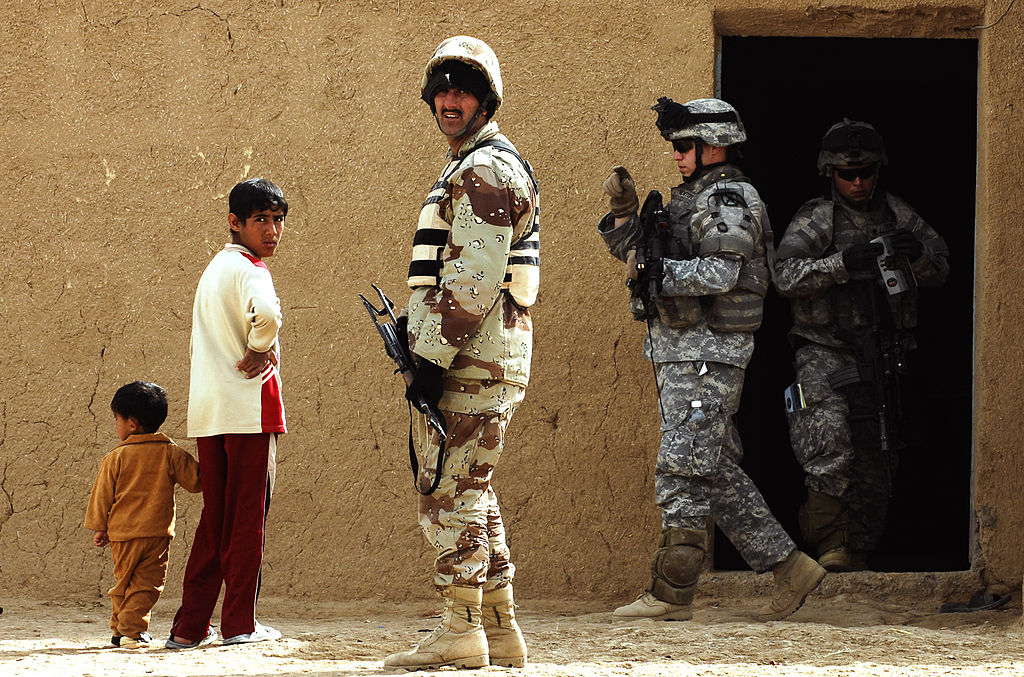
U.S. Army Soldiers from 3rd Battalion, 6th Field Artillery, 10th Mountain Division and Iraqi army soldiers conduct a four-day mission consisting of a cordon and search, humanitarian aid and building relations with local Iraqis in Kirkuk, Iraq, March 3, 2008. (U.S. Air Force photo by Staff Sergeant Samuel Bendet)
Are we then forced to be impotent bystanders, merely reporting but not acting? But even neutral news reportage is not without problems; the spotlight of the world’s massed media can inflame tensions. As both government and opposition forces appeal to the worldwide audience, it is hard to resist being drawn into making a judgment, and distracts from working towards a solution on the ground. In some cases the media are even more of a hindrance, the relief effort in Haiti was actually impeded by the mass of foreign journalists rushing to get their coverage, blocking up runways that were needed for aid. Protestors during the Arab Spring uprisings complained that although they had the world’s media watching them, they did not receive the physical support they needed. This is not a nature documentary; where the presenters impassively stand by as lion cubs are trampled because they mustn’t interfere with nature, these are dying children on our screens not animals. An accusation often leveled at the makers of aid appeal videos, filming the destruction without actually helping is worse than doing nothing at all.
It is these questions of national sovereignty versus ‘doing good’ that the new problems of globalisation are framed against. These are questions with no obvious, or easy answer. Every time we campaign against Putin’s new anti-homosexual legislation in Russia, and every time a Taliban official rails against the cultural imperialism of the west, we become more and more embroiled in this multicultural paradox. No issue can ever be isolated into local politics these days, because we all know too much. We must watch events unfold around the world and what’s harder, sometimes choose to do nothing.
About the Author






[…] http://archive.the-ipf.com/what-does-globalisation-mean-for-us-today/ […]