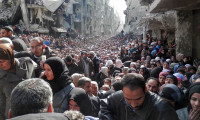
With no end to the civil war in sight, the Syrian refugee crisis continues to reach staggering proportions. Amidst international concern over how to respond to this humanitarian emergency, Jordan has been applauded for its open-door policy which has allowed over a million Syrians to take refuge in the country since the outbreak of violence. But as the number of refugees continues to rise, so does the strain on Jordan’s fragile political and economic balance. In particular, for a country which has struggled to construct a unified national identity ever since independence, it is important to consider what political implications Jordan’s status as a host country for large numbers of refugees will have in the long term. What does the refugee crisis mean for Jordanian national identity?
The nation-building project, so central to Arab politics in the twentieth century, takes on particular importance in Jordan. Of all the mandates carved out of the remains of the Ottoman Empire after the First World War, Jordan was arguably the most artificial. Its borders were drawn by the British for the sole purpose of creating a throne for Prince Abdullah I, and it had no reason to exist as an independent state – it lacked resources, had no major trade links and was inhabited by disparate tribes with little experience of centralised government. From the outset, the challenge of building a Jordanian national identity was a crucial task for Jordan’s new monarchy.
But Jordan’s location in the turbulent heart of the Middle East has not made this task very easy over the years. The country’s long border with Israel has meant that it has been subject to a never-ending barrage of refugee flows corresponding to the upheavals of the Israel-Palestine conflict, most notably around 1948 and 1967. There is now widespread agreement that Palestinian-Jordanians make up the majority of Jordan’s population. UNRWA statistics show over 2 million registered Palestinian refugees living in the country, although the monarchy refuses to confirm these figures by carrying out a national census. Since 2003, the Palestinian refugees have been joined by hundreds of thousands of Iraqis fleeing in the wake of the US-led invasion. And now, Syria’s descent into civil war has caused another major surge of refugees. The Syrian-inhabited Zaatari refugee camp is now effectively Jordan’s fourth-largest city and the second-largest refugee camp in the world.
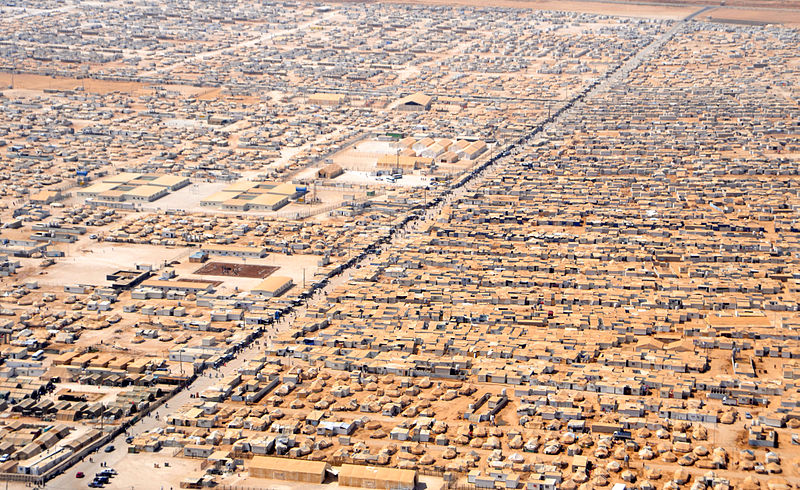
A close-up view of the Za’atri camp for Syrian refugees as seen on July 18, 2013, from a helicopter carrying U.S. Secretary of State John Kerry and Jordanian Foreign Minister Nasser Judeh. Image credit: U.S. Department of State
Over the years, the sheer number of refugees living in Jordan has created a number of issues for the political life of the country. First of all, refugees have been seen as a challenge to the integrity and legitimacy of the Jordanian regime. The fact that Palestinians make up the majority of the population feeds into the “Jordan is Palestine” rhetoric that has emanated from Israel over the years, which suggests that Palestinian claims to self-determination could be satisfied by the establishment of a Palestinian state in Jordan. This is an obvious threat to the regime’s power and to Jordan’s viability as a nation-state. Few have forgotten the days when the Palestinian Liberation Organization established a “state within a state” in Jordan, which came to a bloody conclusion with the events of Black September in 1970. Today, suspicions of Palestinian-Jordanians as disloyal citizens linger and are reflected in periodic calls for Palestinians to have their citizenship revoked, usually in response to developments in Israel.
The refugee situation also poses a challenge to the key constituencies which have traditionally kept the Hashemites in power. The monarchy has long based its support on the loyalty of the East Bank Jordanian tribes. The East Bankers enjoy a privileged relationship with the monarchy, which gives them access to free education and public sector jobs, and they fill the ranks of the army and the state intelligence services. But the growing refugee demographic threatens their privileged positions and has begun to provoke a backlash in recent years. In 2011, a group of tribal leaders took the unprecedented move of openly attacking Queen Rania, who is of Palestinian origin, calling her “a danger to the nation and the structure of the state.”
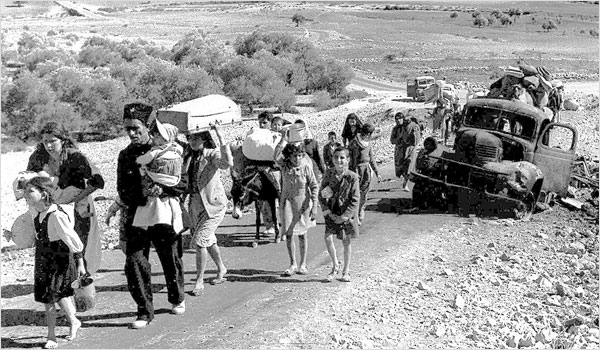
Palestinian refugees (British Mandate of Palestine – 1948). “Making their way from Galilee in October-November 1948”. Image credit: Fred Csasznik
Faced with these challenges, King Abdullah II has undertaken several measures since his ascension to the throne with a view to fostering a sense of Jordanian patriotism which could be channeled towards supporting Hashemite rule. His Jordan First campaign could be described as an attempt to construct a national identity defined in territorial rather than pan-Arab terms and to foster loyalty to Jordanian interests above all others. This follows naturally from his father King Hussein’s disengagement from the West Bank in 1988 and recognition of Israel in 1994, which were part of a larger strategy of steering the course of Jordanian politics away from the Palestinian issue. The Jordan First campaign has manifested itself in the increasing prominence of slogans, flags and pictures of the king in Jordanian public spaces in an effort to create allegiance to specifically Jordanian symbols.
http://www.youtube.com/watch?v=azBF0le38dA
The Jordan First campaign, however, has been met with unease by many who distrust its political motives. The brand of Jordanian nationalism encouraged by the campaign implicitly excludes and delegitimises the Palestinian identity, and can be seen as one element in the monarchy’s deliberate policy of cultivating divisions between East Bank and West Bank Jordanians. As part of this policy, the monarchy reserves high-level government positions for East Bankers and discriminates against Palestinians. Palestinian-Jordanians are kept in a precarious position and live in fear of being arbitrarily stripped of their citizenship at any time. At election times, the one man, one vote rule encourages voting along tribal lines, favouring regime loyalists, while gerrymandered electoral districts prevent Palestinians from exerting a political influence commensurate with their numbers. A state-sponsored national identity of this type, geared towards maintaining regime power, could become a cause for concern, especially if this identity starts being constructed in exclusivist terms, and patriotism turns into resentment and hostility towards non-East Bank Jordanians.
With the new wave of refugees, which is creating mounting pressure on Jordan’s economy, there is a worrying possibility that attitudes towards refugees could continue to sour. The Syrian refugee population is causing strain on Jordan’s scarce water supply as well as its schools and clinics. Jordanians fear that the influx of Syrians desperate to earn a living will push wages down and heighten the competition for scarce jobs. At the same time, the government has been lifting subsidies on electricity, water, fuel and bread which has led to higher prices for everyone. It should be noted that rises in gas prices have sparked protests in the past. While at first Jordanians were eager to welcome Syrians as fellow Arabs fleeing oppression, there are signs that the refugees are beginning to wear out their welcome.
Ultimately, the only long-term solution to the refugee crisis is the resolution of the conflicts in Palestine, Iraq and Syria, which would not only relieve the pressure on Jordan’s borders but also create a stable environment in which to pursue economic development. But as long as this vision remains a far-fetched reality, observers should keep a close eye on political developments in Jordan. King Abdullah, like the other remaining monarchs in the region, is in a precarious position given the protests that have shaken the region in the last few years and will have to make careful calculations to ensure his continued power. We can only hope that his chosen strategy does not come at the expense of Jordan’s most vulnerable residents.
About the Author