
On February 12th 2014 (the Day of the Youth in Venezuela) students took to the streets of Venezuela to protest. This much we know. But unfortunately for Venezuelans, the crisis in Ukraine has captured the attention of the international community overshadowing that of Venezuela, despite the fact that protestors have been calling for international coverage from day 1. Since protests began, the government has been censoring media coverage and websites; it has taken off air international news channel NTN24, and temporarily blocked twitter in an attempt to keep the civil unrest quiet. Radio stations and newspapers have been told not to report on the protests as it contributes to the violence, and Globovisión, the last nationwide network in the country, was recently bought by an entrepreneur with strong ties to the government. As a response, students have been calling for the spread of information via social media.
Huffington Post One Young World Ambassadors
How did it start?
The protests started on the 4th February, after the attempted rape of a student in the state of Táchira, and quickly spread to the city of Merida, where the University of the Andes is located. Protests were met with unnecessary force by the National Guard, so demonstrations multiplied throughout the country; a lot of rage has been waiting to explode. However, Táchira as a starting point for national protests is no coincidence. The state profits immensely from the illegal trade of contraband to Colombia, leaving little supplies on the shelves for its citizens. It is estimated that 30% of basic food products leave Venezuela as contraband. Drawn to Táchira by this profitable trade, Colombian and Venezuelan paramilitaries plague the state bringing with them the presence of transnational criminal networks and the threat of kidnapping.
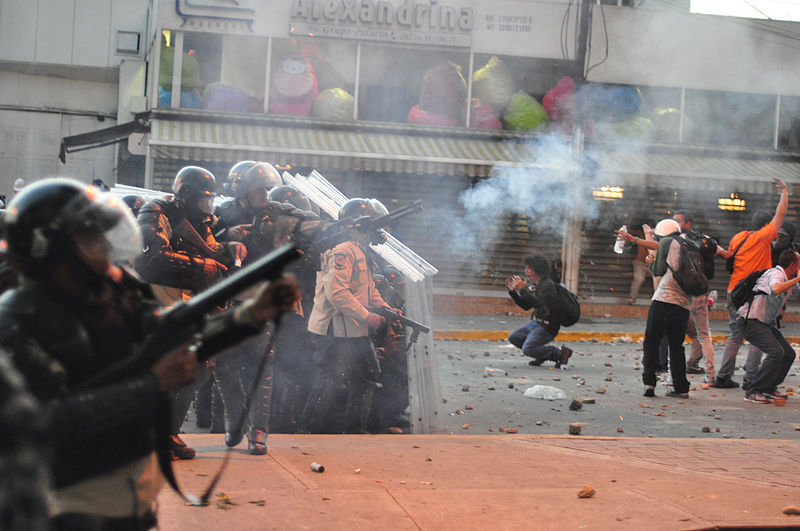
Tear gas, and plastic pellet gunshot used by Venezuela’s National Police against a protest in Altamira, Caracas. Image credit: Andrés E. Azpúrua
Why is it happening?
In short, because of social and economic insecurity.
• Venezuela is the second-most dangerous country on the planet, where every 21 minutes someone is brutally murdered.
• In 2013, there were 24, 700 violent deaths.
• Since April 2013 when Maduro took office, Venezuela has seen an inflation rate of 56%, as well as a 50% increase in budget deficit.
• The currency has dropped from an 8 to 1 exchange rate against the dollar, to 87 to 1 since Chávez’s death.
• Items such as milk, toilet paper, sugar and bread are extremely difficult to find, and Venezuelan’s find themselves queuing for hours just to be able to eat.
• The government has a reputation for lack of transparency; recent media censorship confirmed this.
• Government-backed violence by the sponsored paramilitaries has killed at least 17 people to date.
• Government repression and a lack of freedom of speech are rife throughout the country.
• According to the Human Rights Commission in Caracas, to date there have been 400 peopled detained. 197 have been released, 6 are disappeared, and 8 have been formally convicted and shall not be leaving jail. Other sources claim as many as 1 000 have been detained since the protests began.
• There have also been reports of torture.
Huffington Post One Young World Ambassadors
Who is involved?
Nicolás Madero
The current President of Venezuela. It is important to remember that while the protestors have substantial influence, Madero and his PSUV party is not without its fair share of supporters, with approval ratings still hovering above 40%. Although a weak leader, there is no military force which would turn against him. He remains in favour with the police, Chavismo, and parliament, meaning Madero is unlikely to suffer the same fate as Ukraine’s President Yanukovich. Those repressing the protests (the Bolivarian National Guard, Bolivarian National Intelligence Service, and paramilitary groups) are tightly linked with Madero’s government, and so far media outlets are obeying his wishes to minimise reporting on the protests.
Leopoldo Lopez
The charismatic political figure on the verge of replacing Capriles as the leader of the opposition, arrested on 18th February 2014. A Harvard- educated economist, he turned himself in after learning news of his arrest warrant in connection with inciting violence and the deaths of 4 anti-government protesters, which he has denied. In a speech made before his arrest he stated, “I am handing myself over to an unfair justice system, may my imprisonment serve to wake the people up”. He remains in a military prison. Amnesty International and Human Rights Watch have said his arrest “smack[s] of a politically motivated attempt to silence dissent in the country.”
Students and anti-government protestors
Although the protests began when a group of students got together in San Cristóbal, the anti-government protestors have spread out and now encompass all age groups, coming from all walks of life. However, the majority are from wealthy neighbourhoods, and many areas in Venezuela are unaffected. Madero estimates that just 5% of Venezuelan’s support the opposition, and although this figure is thought to be much higher, it is unlikely that ‘La Salida’ (the exit) of the president will occur unless the protestors gather more support.
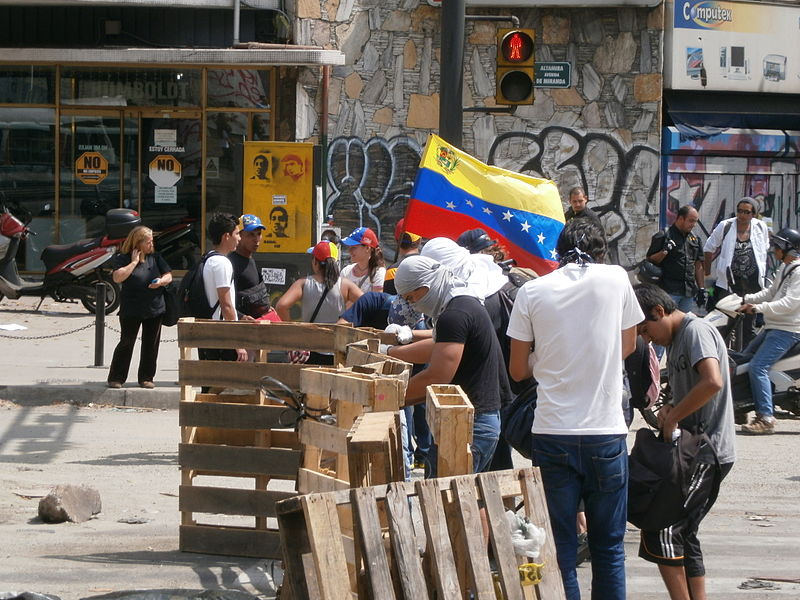
Venezuela protests against the Nicolas Maduro government, Altamira Square. Image credit: Wilfredor
The International Community
The USA has found itself in Madero’s bad books, who believes there is a U.S. plot to destabilise the government. Last week he gave 3 US diplomats 48 hours to leave the country, shouting “Yankee, go home” to his supporters. To which Obama responded,
“Venezuela, rather than trying to distract from its own failings by making up false accusations against diplomats from the United States, the government ought to focus on addressing the legitimate grievances of the Venezuelan people.”
Ukrainian tweeters stepped forward to post their support for the protesters in Venezuela, and Colombian and Uruguayan officials have offered to mediate peace talks, if needed. Brazil and Argentina have called for no foreign intervention.
What are the protesters hoping for?
Since the unrest spread throughout the country, protesters have gathered a collection of demands, ranging from the liberation of political prisoners to the stabilization of basic amenities, including water, food and electricity. Although ‘the principal purpose of the protests [is] to destabilize the government and seek the ouster of the democratically elected president of Venezuela, Nicolás Maduro’ (Miguel Tinker Salas), the unrest has been described as ‘a movement without a center’, essentially boiling down to the different demands of different economic classes.
In Caracas the majority of protesters are middle-class students, who are demanding the resignation of the president, a rejection of violence and liberation of political prisoners, including opposition leader Leopoldo López, and countless protesters.
However in the interior of the country where the lower classes generally reside, they are hoping for longer-term solutions to raise their standard of living. They focus on problems of soaring inflation, scarcity of basic goods, and a lack of water and electricity.
How will it develop?
Ian Bremmer, the president of Eurasia Group, after analysing the crisis in Venezuela has predicted the outcome of the situation on Reuter’s blog entitled “This is not Ukraine: Venezuela will erode, not explode”, and it looks to be heading that way. The protestors do not have enough force behind them: there is no organised centre, it is a demonstration of many facets, and one which the government is riding out until businesses and civilians tire of the unrest and discourage the protesters. There is no organised group backing the protest, “with a platform, a network and the logistics to overthrow the current government.” Currently the only body with the power to remove Madero is the military, and they are unlikely to do so given their support of Chavismo. And nothing, insists Madero’s officials, “can stop Mr. Chávez’s socialist revolution.”
Meanwhile, the violence is likely to continue (dissatisfaction will ensure that it does) and then peter out. Bleakly, no real outcome has been predicted for the protestors. If anything, it seems that the uprising may even reinvigorate the failing government.





