
The events that have been unfolding in Hong Kong lately probably have left many, especially in the West, wondering what’s up with this city that has long been considered a bridge and melting pot between East and West. Although it belongs to China, looking at the current events reveals how unlike China it really is.
To outsiders, many of the current events must seem rather baffling. Young people are taking to the streets, effectively paralysing Hong Kong’s vibrant economy in their quest for democracy.This is however happening in a country with a notorious track record of political repression and human rights violations.
The Hong Kong Police Force’s initial answer to the peaceful – though technically illegal – occupations was not surprising; it relied on non-lethal force, especially tear gas, in the attempt to dissolve Occupy Central‘s blockades of vital hubs to the city’s economy. Arguably, there was no significant difference to police tactics used in the West to dissolve demonstrations considered a threat to public order. This is not to claim that the Hong Kong protests at any point actually posed such a threat, but no matter how one views their legality and legitimacy, the case for the restraint exercised by the Hong Kong Police remains.
But the people of Hong Kong where shocked and infuriated by even this amount force used by their traditionally pacifist police. As a result, the ranks of an initially marginal group of pro-democracy protesters (compared to a population of 7 million) quickly swelled, raking in thousands from the general population.
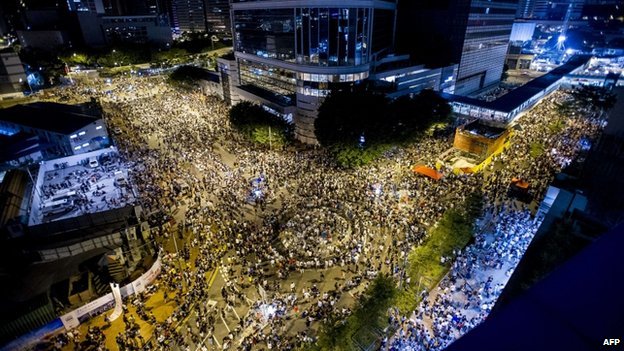
Protesters gather during a demonstration in Hong Kong on September 28. Image Credit: BBC
Meanwhile, Hong Kong’s Chief executive C.Y. Leung seems to have switched strategies and plays a waiting game. It looks like an attempt to sit out the protesters, hoping that the prolonged disruption of the daily lives in the city will soon sway public opinion against them. The way the events are currently unfolding, it looks like this strategy may succeed.
Different cultural identities: China and Hong Kong
In order to truly make sense of the Hong Kong protests, one has to be aware of China’s and Hong Kong’s distinctly different histories and their resulting differing cultural identities. One is “a tale of colonialism, liberal capitalism and Western influence, the other the story of a reunified, resurgent and nationalist nation recovering from a century of humiliation”, as my friend and former classmate at the University of Hong Kong, Joe Dobbs, eloquently put it in a recent article for The Diplomat.
After the handover of the former British colony back to China in 1997, many Hong Kongers, despite never actually having enjoyed true liberal democracy, were understandably worried about their city’s return to the mainland. Under British rule they acquired and internalised many key values at the heart of liberal democracy (short of free elections, of course) such as freedom of speech, freedom of the press, and freedom of assembly – all of which are natural enemies to the PRC‘s all-powerful Communist Party.
The eventual compromise, which became to be known as “one country, two systems”, was designed to soothe both Hong Kong and British (i.e. Western) worries and to serve a rising China’s needs. In order to do so, the sustained economic potency of a city that had by then become one of the world’s major financial hubs, precisely because of its highly liberal (market) order by the way, had to be ensured.
Economic and political freedoms
For 50 years, Hong Kong’s autonomy, i.e. its economic and political freedoms, were to remain untouched.
Officially maintaining the unity of one country, but allowing two completely distinct economic and political systems to co-exist within it, naturally produces a number of paradox and potentially disrupting issues. Hong Kong has its own currency, Chinese people from the mainland need a passport to cross the border to Hong Kong just like everyone else does, and in the 2008 Beijing Olympic Games Hong Kong competed along China with its own team. The obvious differences in history and culture, as well as the attitudes of Hong Kongers vis-a-vis Mainlanders and vice versa, have manifested themselves in growing tensions and conflict potential for quite some time now. Additionally, the influx of rich tourists and real estate speculators from the mainland has contributed to housing prices soaring to startling heights, even for Hong Kong. All this added to increasing local resentments against the traditional alliance of Beijing with the city’s elite of business tycoons and a perceived encroachment from the mainland.
With this in mind, the roots of the Hong Kong protests organised by Occupy Central can be traced back to two interrelated underlying factors:
Politically, many Hong Kongers who are well-educated and were brought up in a prosperous, cosmopolitan and liberal environment, unsurprisingly seem to have developed a genuine longing for true democracy, in line with what has famously been described as modernisation theory in the tradition of S. M. Lipset.
In economic terms however, the encroachment from Beijing is also seen by many as festering cronyism and corruption, while forming an unholy alliance with local business tycoons, rich investors from the mainland, and the Chief Executive himself.
Together, these factors help to explain the formation of the protests as emerging from an idealistic, mostly student-led pro-democracy camp, reinforced by Occupy Central and other democratic veterans, but also as drawing momentum from economic discontent and widespread sentiments of social injustice. Yet there is more to the story, which helps us outsiders to understand why not only young idealists took to the streets, but were joined by many more, old and young, from the general population in an angry reaction to the police’s use of force when trying to dissolve the initial protests.
Listening to both sides
The protesters demand universal suffrage, which has been promised by Beijing but is interpreted very differently by both sides. Currently Hong Kong’s chief executive is elected by a committee that effectively and unsurprisingly represents mainly the city’s business tycoons. In the new version of the law the Chief Executive would be publicly elected, but will first have to be nominated by a very similar and equally unrepresentative committee.
Even more, many people in Hong Kong fear that not only may Beijing never fulfill its promise of universal suffrage by 2017, but even take away or at least gradually erode their current freedoms. To make matters even worse, memories of the Tiananmen square massacre are held very alive in Hong Kong. Any violent attempt to silence peaceful protests is thus not only seen as an outraging violation of the city’s fundamental values, but at the same time summons painful memories of a past pro-democracy protest ruthlessly quelled in bloodshed.
As an outsider, all this helps to understand why Hong Kong people have reacted the way they did, but it is equally important in this difficult situation to understand Beijing’s position. The PRC’s central government arguably has to base its legitimacy almost entirely on economic growth and social harmony. In working towards these goals, the government is convinced of having to maintain a firm grip on power by tightly controlling pubic opinion and suppressing dissent at all costs. The experience of the Soviet Union’s Glasnost further taught the Chinese Communist Party how infectious of an idea democracy can be.
However, Beijing should also be aware that, due to the high degree of political freedoms Hong Kong already enjoys under “one country, two systems”, the status quo will be difficult to sustain. Hong Kongers, especially young ones, have begun to demand evermore political freedoms – either Beijing can start to grant them, or it will have to take some other freedoms away in order to oppress these demands.
In a best-case scenario, the result would likely be a diaspora of the educated, young population. Such a brain drain could significantly hurt Hong Kong’s competitiveness as a major business hub. In the worst-case scenario, the situation could deteriorates to a point where some observers’ nightmarish worries about an escalation of violence, complete with intervention from the Chinese military, could actually become true.
The good thing about being an outsider is that it allows one to retain a rather neutral stance in paying equal attention to the position of both sides in a conflict like this one. I believe that there may be ways out of the current stalemate, but any solution would require true and mutual concessions from all parties in order to reach a compromise everybody can live with. Occupy Central’s demands for “full democracy, now!” are, as many observers have pointed out, sadly unrealistic. But Beijing’s immobile hardline position is equally unsustainable, even if the current protests can be navigated.
The need to fix a fundamentally broken relationship
Both sides need to accept their counterpart’s fears and needs, if this vexing problem (not only the current protests, but the fundamentally broken Hong Kong/China relationship itself) is to be resolved in a peaceful and mutually satisfactory manner. Hong Kong people fear increasing encroachment from Beijing and the mainland, which they feel threatens their political and economic freedoms, their way of life and their perspective on their life. Beijing conversely fears that any concessions made to Hong Kong may be interpreted as weakness at home and abroad, leading to a domino effect of dissent that could undermine the party’s authority and dangerously destabilise the country.
In assuaging each other’s fears, neither the demanded free and fair public election of the Chief Executive, nor the enacted pre-selection of candidates by a pro-Beijing committee, will be useful. Both sides therefore need to get creative in crafting alternative proposals, which seriously consider the concerns of their counterparts.
In light of the frequently attested (and readily observed) crisis of Western liberal democracy, perhaps the pro-democracy protesters should reconsider whether the popular election of their leader is all that matters in the first place. Popularly elected leaders can by no means guarantee an effectively functioning democracy. Given that such a demand seems to be out of the question for the foreseeable future anyway, due to the Communist party’s sheer inviolable power, the current situation should be more wisely used to obtain other meaningful concessions. This could help to safeguard Hong Kong from a gradual erosion of its current degree of political freedom while trying to expand on that in other ways. Even with a non-elected pro-Beijing Chief Executive, measures such as direct democratic influence for example, could help to counter excessive influence from pro-Beijing and pro-Business interests. Aimed at concrete local policies concerning the quality of life of the people of Hong Kong, this could strengthen civic culture and political participation without having to alarm Beijing. Hong Kong people would gain more real democratic influence on the matters concerning them the most, but the CCP could rest assured that the city would continue to operate within the overall framework sanctioned by the party.
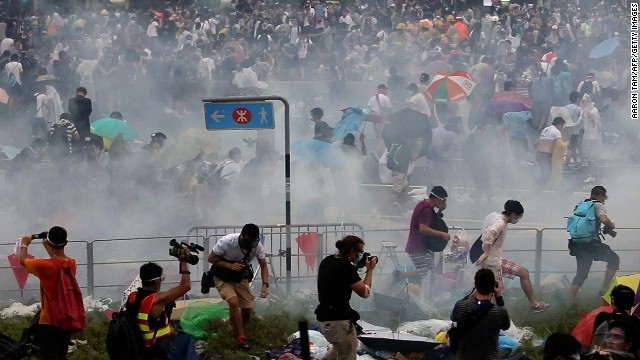
Police clash with pro-democracy protesters in Hong Kong. Image Credit: Nsempii
Beijing in turn should consider to once again cherish the old Chinese principle of “touching stones to cross a river”. For the case of Taiwan’s reunification with the PRC, it repeatedly offered a “one country, two systems” solution similar to Hong Kong. Taiwan however, which is an economically highly developed, fully-fledged democracy, will never voluntarily accept to significantly cut back its current level of political freedoms to rejoin the mainland. Now the central government under Xi Jinping has the chance to conduct a political, localised experiment in Hong Kong, similar to the way Deng Xiaoping began to experiment with neighboring Shenzhen in economic matters in the 1980s. A constitutional safeguard cementing the faithfulness of Hong Kong to the Chinese nation and thus ensuring national integrity alongside free and fair elections could be one possible approach. Even a popularly elected Chief Executive would then still be bound by a constitution supplied and legitimised through the CCP.
From an outsider’s perspective, it may not be too easy to fully grasp the unfolding events around the Hong Kong protests. In the sincere effort to do so however, we have the chance to look at these events in a more neutral way than any of the involved parties may be able to do. In order to avoid misery and bloodshed it is paramount in any delicate conflict, to bring both parties to the negotiation table, instead of seeking open conflict that risks the confrontation to spiral out of control and potentially result in violence. If the fissures between Hong Kong and Mainland China, which have been building up over the years after the handover and are now manifesting themselves in form of the current protests, are to be patched, this will only be possible through meaningful negotiation seeking compromise by both parties.
About the Author





