
Around one billion children in the world live in conflict-affected areas, according to the European Union. As conflict begins, their childhoods disappear. Suddenly they live at risk of losing their education, their homes and their own lives.
When an armed conflict arrives in a child’s life, their childhood can fall apart. Their most basic human rights disappear; access to education becomes difficult if not impossible; children become vulnerable to recruitment by armed groups, and many of them usually end up becoming refugees in their own countries. Sexual violence and forced labour are other serious consequences in the lives of the children who spend their childhood among armed conflicts.
“In a conflict situation, children are robbed of both their right to learn and their right to live as children. They are forced to confront violent realities too early, forced to experience terror too often. They also have to contend with post-conflict trauma,” says Famita N. Somogod in her article “Where there are no schools”. She describes the situation during the counter-insurgency operations of the Philippine army. She works with the rural missionaries in the Philippines in order to protect communities, and especially their children, from rebel groups.
More than 28 million children affected by armed conflict do not attend primary school. Most of those children that have no access to basic education have been displaced from their homes due to civil wars. Children are in vulnerable situations like this in more than 23 countries where there are armed conflicts, according to the UN. In places like Ecuador, Central Africa and South and Western Asia, children’s lives become even more complicated when they have to move to another area because their own home has become too dangerous. More than half of the refugees in the world are children, according to Unicef.
In 2013, around seven million children were refugees and about 12 million children were internally displaced in their own country due to conflict, the UN Refugee Agency has estimated. It turns out that when civil populations are internally displaced, they often end up living in very remote areas where there are no resources for education. This is the case in Ecuador, where more than 5,000 children have been affected by this issue.
Ms Silje Skeie, senior education advisor at the Norwegian Refugee Council, alerts about the importance of education: “Children and youth affected by conflict prioritise education. For them, education represents normality, safety and hope”.
Sudan is another country with a high number of refugees, most of them living now in Chad. Thousands of the refugees are children deprived of primary education. In Afghanistan, more than 600,000 people have been displaced from their home due to armed conflicts, again impacting the access of children to education. The report notes that only 10 per cent of Syrian child refugees living in Iraq receive education. In many countries where there have been regular armed conflicts, the education system has collapsed for years afterwards.
The EU points out that around 300 million children in the world under five-years-old live in countries affected by conflicts. Living in these areas, children are exposed to sexual violence. For instance, the UN reports on the common practice of Baccha Baazi (dancing boys) in Afghanistan. “This kind of sexual slavery and child prostitution, in which boys are sold to wealthy or powerful men, is a widespread phenomenon,” the report says.
Child recruitment by armed groups is another major concern for groups involved with children living in conflicts. In 2009, there were more than 250,000 child soldiers. The United Nations reported in 2014, among many cases, the recruitment of more than 1,200 children in Somalia by the Somali National Army, allied militia and Al-Shabaab. In a number of cases, some of the children also suffered sexual violence.
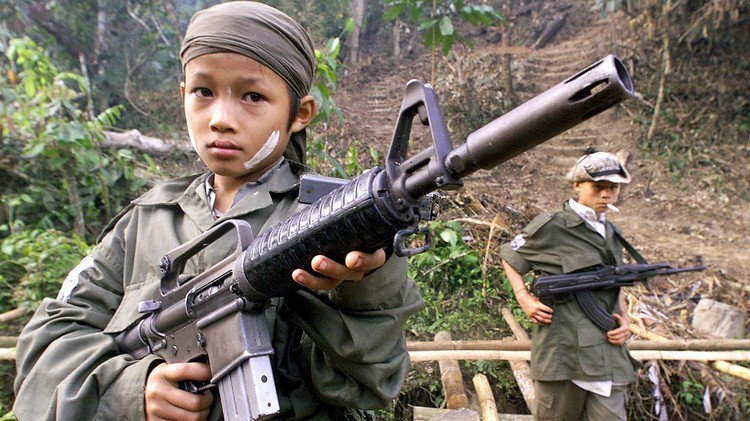
Child soldiers. Image Source: http://bit.ly/1aWIgMm
Despite the circumstances under which these children grow up, it is possible to take small steps to make their childhoods easier. Along with the EU, Denmark is working in the Central African Republic to provide access to education for almost 15,000 children and psychological assistance to more than 1,400 children.
In the Democratic Republic of the Congo (DRC), the EU and the Norwegian Refugee Council (NRC) have repaired schools and education spaces. In this way, over 9,000 conflict-affected children have been given safe access to education. The children who benefitted from NRC’s ECHO project in Eastern DRC also told us that school was where they felt safest; where they did not fear the militias or being raped. Humanitarian actors need to listen to children when they tell us that education is what they want, and make sure that all children affected by conflict have their right to education fulfilled.
Many other countries like Chad, Aghanistan, Iraq, South Sudan, Somalia and Burma have also been able to return access to education to thousands of their children. This is the first step in rebuilding their broken societies.
About the Author





