
Conviction politicians are applauded while those who flip flop around issues or commit U-turns are lambasted for not being decisive enough. This second sort are not leaders who inspire confidence in the electorate. But why is this? Do we really want politicians who stick to their guns no matter the reality of the situation, the outcomes of their policies or the evidence piled up against them? Or do we instead want politicians who weigh up both sides of the argument before reaching an informed decision with an understanding that this policy will be frequently reassessed to ensure that the policy initially chosen remains the best course of action?
Look at the British economy. The Conservative-Liberal Democrat Coalition government, under the economic stewardship of Chancellor George Osborne, claimed in 2010 that austerity measures and cutting of the public sector would cut the budget deficit substantially and create a decent level of economic growth thanks primarily to the private sector picking up the slack. He was wrong. Business investment has fallen and we have been left with a higher debt level than in 2010. Indeed, the governments prediction in 2010 that, by 2013, the economy would be about 7 per cent larger than it is has proved totally wrong with the economy only just starting to grow at any decent rate in 2013.
This is the evidence presented to Osborne. He stated that his policies would, on the basis of his economic ideologies produce certain outcomes and they have clearly not achieved this goal. Nonetheless he preserves with it, claiming that (at least publicly) these policies will work in time. However, in the background, and when faced with damning numbers, Osborne did relax the pace of his deficit reduction strategy. This shows he is not totally unaware of the importance of making decisions based on reality.
http://www.youtube.com/watch?v=RO-3nD-fJ4I
So why has he not changed his mind and openly admitted that his austerity policy has not worked when his chancellorship has witnessed the “weakest and slowest recovery in the UK’s recorded history”? There are many potential explanations for his belief that turning back now would be a disaster. One might be that he believes that it is not the fault of his policies but outside influences like the eurozone which is throwing him off his game. A second, more straightforward, is that he is a derp; refusing to alter his position regardless of how strong the evidence against it is. But more worryingly, it may be that he is fully aware that his policies are flawed but is unable or unwilling to act due to political pressure and the importance of being seen to be ‘in control’.
I largely reject the first two reasons based on my optimism that someone would not be able to rise to a position of power without an inability to critically analyse arguments and evidence as well as taking the context of decision making into account.
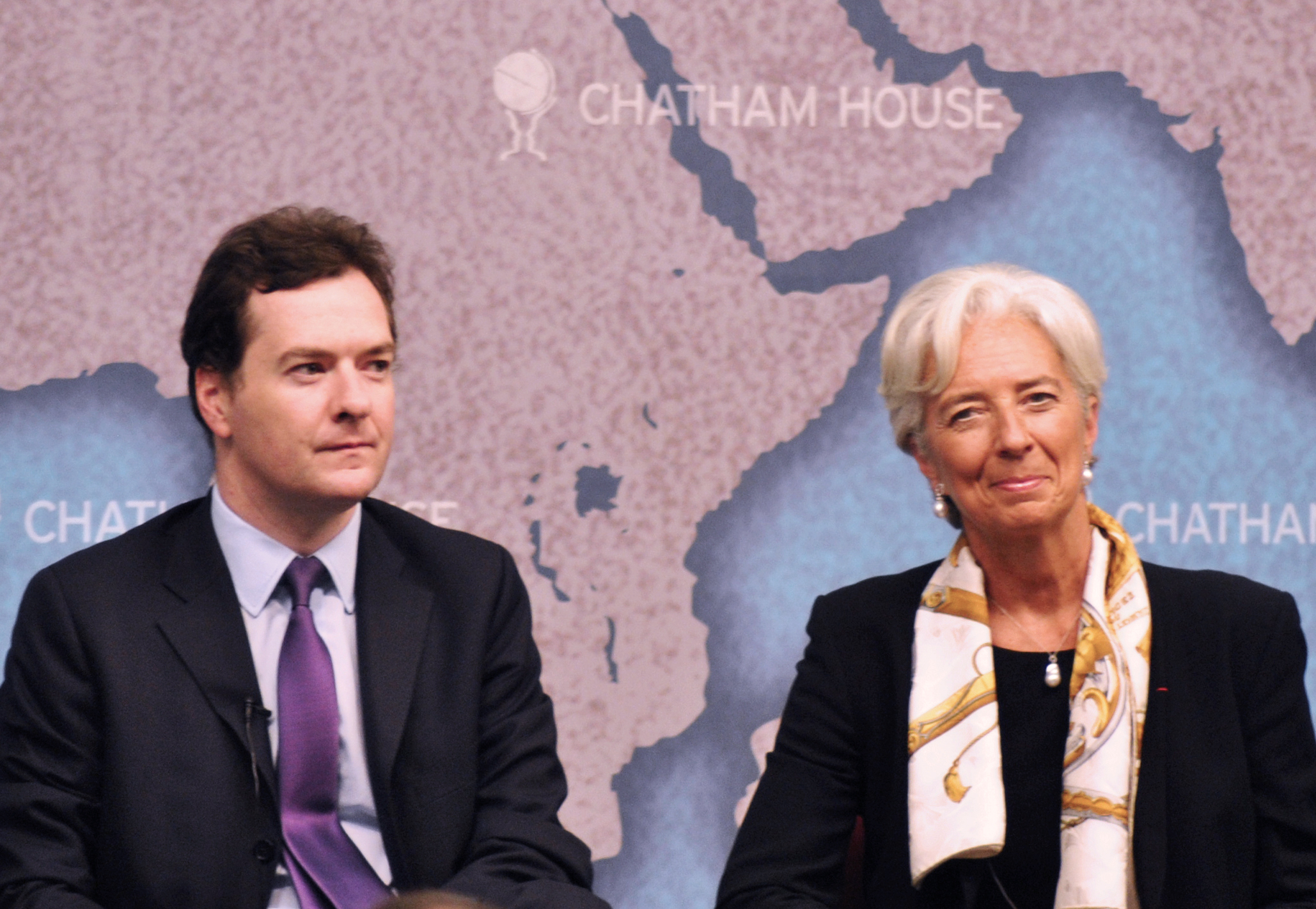
George Osborne and Christine Lagarde. Image credit: Chatham House
The third reason is interesting as it implies that politicians think the electorate, while claiming to distrust politicians immensely and thinking they are all just self-seeking, in fact has enough faith in their representatives to assume they will make ‘correct’ decisions. If this was the case though, why do the public not accept politicians who change their mind? Even those politicians who say that new evidence has come to light which must be considered, are often implicitly criticised for using evidence rather than just ‘knowing’ the right course of action. There is a sense that it is weak to do this rather than taking a purely common sense approach to decision making.
So what is/can be done to change this?
1) Change the climate of opinion: There is a push to get politicians to start looking more at using research and evidence when making decisions. This is seen by the fringe event put on by The Alliance for Useful Evidence. This should be commended but also raises questions as to why there is a need for a body to exist to encourage politicians to create more evidence informed policy rather than this being a given.
2) Learning from Nixon: While Nixon got a lot of things wrong, he was certainly correct when, being warned that changing his decision would lead to criticisms of ‘flip-flopping’ he said that “circumstances change”. This approach is sadly lacking today and, whilst strange to say, there are many politicians who could learn something from Nixon in not being afraid of accusations of weakness.
3) Government responsibility: There is a public perception that U-turns are more about changing one’s mind than actually about taking an informed decision if circumstances change. This has been reinforced by the current government which changes its mind even when no new evidence comes to light. Politicians should make decisions based on evidence and not be afraid to explain how they reached such a decision.
4) Media responsibility: Media outlets must let politicians explain their decisions and how they made them rather than seeking sound bites (which the politicians in turn seek to give). The public are not only interested in how they dress or lazy caricatures; most actually care about how and why the country is being run in the way it is.
Unfortunately, the public (and therefore politicians) are caught in a paradoxical situation where there is a willingness to berate someone for not looking at all the evidence whilst criticising them if they change their mind based on evidence. We must accept that politicians are normal people too and do not know everything. A U-turn should not necessarily be a criticism.
About the Author






I totally agree. Our media and politicians assume the electorate are infantile. they certainly treat us as such. We are able to understand that (a) a policy seemed appropriate at time X, but is no longer so at time Y (b) if there is good evidence that a policy hasn’t worked, we don’t want failure to be reinforced through use of our taxes or further damage to the economy or society (c) policies based on evidence rather than conviction (d) policies which require a certain amount of explanation and long words rather than a snappy sound-bite. Our “yah-boo” politics doesn’t help. personally, I’d applaud Ed Milliband for say not just the Labour got in wrong in some areas in the last Government and that he did too – and point out that he’s learnt from that – as opposed to the present Government which appears to be stuck in an ideological cul-de-sac of its own making.