
Every year on the 6th of February, the world recognises a day of “Zero Tolerance to Female Genital Mutilation” (FGM). Unfortunately, despite this day being recognised by the United Nations, not many people are aware it exists. It is currently estimated that roughly 140 million girls and women around the world are living with the consequences of FGM. In Africa alone, over three million girls are subject to being at risk from FGM every year. Yet, nothing is being done about it and, in fact, few people are aware of the facts behind this awful tradition.
While it may be difficult to read and talk about this issue and while many find it difficult to stomach, it’s important that the international community stand up for the young girls who have been lured into believing that they are “unclean” if they don’t subject themselves to this awful “tradition”. However, we can’t do so until we really know what FGM comprises of. Here are five things about the practice that will make your blood boil and, hopefully, encourage you to take some action against it.
“Female genital mutilation (FGM) comprises all procedures that involve partial or total removal of the external female genitalia, or other injury to the female genital organs for non-medical reasons.”
– World Health Organisation
1. FGM is most common in Africa.
In Sub-Saharan Africa, one in five young girls are forced to undergo FGM. In 2013, UNICEF published a report that detailed the ongoing occurrence of FGM in Africa and the Middle East, pointing out that Somalia had the highest percentage of circumcised women at 98%. Out of the 29 countries analysed in the report, 18 of these countries were in West and Central Africa. NGO “28 Too Many” works to eradicate global FGM practices, but focuses their research on the 28 countries in Africa where FGM is known to be taking place.
The World Health Organisation says that some countries in Asia and the Middle East are also prone to the practice. However, it is important to remember that the practice isn’t constrained within the boundaries of these countries. WHO also estimates that migrants from these areas continue to practice FGM once they have left their country.
![Percentage of girls and women aged 15 to 49 years who have undergone FGM/C, by country. [Image credit: UNICEF report, 'Female Genital Mutilation/Cutting: A statistical overview and exploration of the dynamics of change.']](http://archive.the-ipf.com/wp-content/uploads/2014/02/Screen-Shot-2014-02-04-at-18.22.57.png)
Percentage of girls and women aged 15 to 49 years who have undergone FGM/C, by country. [Image credit: UNICEF report, ‘Female Genital Mutilation/Cutting: A statistical overview and exploration of the dynamics of change.’]
2. These girls and women are peer pressured into circumcision.
What drives most women and girls to conform to the practice of FGM is the social pressure that comes along with it. Because it’s a tradition that has been ongoing for so many thousands of years, being passed on through generations, it takes a lot of strength for a young girl to now stand up against it. Even older women who have been through the horrific experience now find themselves subjecting their daughters to the same practice. It’s the idea that girls who aren’t circumcised are “too sexual” that drives girls and women to bow into it, eager to not be shunned by society who may otherwise consider them to be “unclean”.
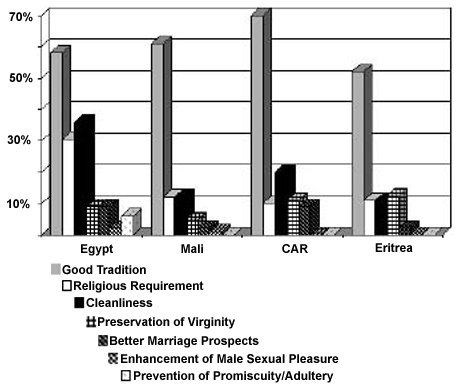
Reasons for Supporting FGM in Egypt, Mali, Central African Republic, and Eritrea [Source: Path.org]
3. “FGM” prevents adultery”… and other myths.
Along with tradition comes myths that have turned into beliefs. While some believe that your first born will die if you are not circumcised, others say that FGM will ensure that girls remain virgins until they are married and that women will stay faithful to their husbands. These assumptions about premarital sex and infidelity are linked to the idea that many communities believe FGM reduces a woman’s libido and, therefore, encourages her to stay away from illicit sex.
Many also believe that girls who have undergone FGM can then be considered “beautiful” and “feminine”, often considering the clitoris to be “manly” and “unclean”.
4. It happens everywhere.
You might attribute these practices only to countries in Africa and the Middle East, and while it’s certainly true that these countries host higher occurrences of FGM victims, female circumcision is happening everywhere. Bringing the story closer to home, it is estimated that 24,000 young girls in the UK are at risk of FGM this summer – despite the practice being illegal in the UK.
Now, a young British girl has stood up to say “enough is enough”. Leading a campaign along with the Guardian, 17-year-old Fahma Mohamed is calling on Michael Gove, Secretary of State for Education, to introduce education about FGM practices in schools around the UK before the summer. The reason for this urgency is because many girls across the UK are sent away during the summer holidays to be cut in their country of origin, giving the summer holidays the horrific term of the “cutting season”. Fahma’s petition states that “if every headteacher was given the information they need to talk about FGM to students and parents we could reach every girl who is at risk before the holidays” and “convince families not to send their daughters to be cut”, as well as “help girls who are at risk”.
5. Infertility, health risks, and death…
Apart from the brutal physical pain of having to undergo such a practice, there are other side effects that come along with undergoing FGM which can have lasting and dire impacts on the women.
According to Women’s Policy, Inc. in areas in Sudan where antibiotics aren’t readily available one-third of the girls who undergo FGM die. Others may go into shock because of the pain, develop urinary tract infections, or experience haemorrhages. In Sudan, 20-25% of female infertility has also been linked to FGM complications.
![Chronic FGM-Related Complications Encountered by Health Providers in Kenya [Source: Path.org]](http://archive.the-ipf.com/wp-content/uploads/2014/02/fgmcrt3.gif)
Chronic FGM-Related Complications Encountered by Health Providers in Kenya [Source: Path.org]
In the long-term, for those who do manage to get pregnant there is an “increased risk of maternal and child mortality due to obstructed labour“. The World Health Organisation estimated that women who undergo FGM are twice as likely to die during childbirth and are also more likely to give birth to a stillborn child. Mohamed Warsame, author of “Medical and Social Aspects of Female Circumcision in Somalia” went on to explain that obstructed labour often also results in brain damage to the infant and complications for the mother, such as fistula formations.
In 1988, 33 infibulated mothers were studied in Somalia. With all of them requiring extensive episiotomies during their childbirth, all their labours lasting five times longer than it normally should, five of their babies dying and 21 suffering from oxygen deprivation due to the long labour, it is safe to say that FGM has consequences far beyond the initial physical pain the women have to undergo. This is something that sticks with these women long after the razor and blade is put away.
FGM is also said to increase the risk of HIV/AIDS in women, due to the razor or blade not being sterilised properly before being used on multiple women and, thus, increasing the chance of spreading the disease from one girl to another.
So what are you going to do about it?
Whether you sign Fahma’s petition or simply watch Channel 4’s latest documentary on the issue to educate yourself further, you can in some way play a role in eradicating a practice that is unnecessary and has no place in the 21st century.
Just image – it could be your sister, daughter, mother or friend. So what are you going to do about it? Share your stories of activism below and inspire a generation to act!
About the Author






[…] This article was originally published on the International Political Forum, written by Priyanka Mogu… […]