
Throughout history, there has always been concern about inequality growing to such an extent that it will become dangerous and imperil social cohesion and stability. When French revolutionaries took the Bastille and began their decades-long struggle for democracy, they were driven by a desire for ‘liberty, equality and fraternity’. When Russians took to the streets to create the first socialist country during World War I, they were motivated by the promise of income equality. But how does the present-day situation compare to these historical cases?
On Monday, 20th January, Oxfam, a British development charity, published a damning report deploring worldwide income inequality. The document presents extremely worrying evidence, such as the fact that in a majority of the countries surveyed inequality has been on the rise for the past 30 years, or the finding that since the financial crash in 2009, the wealthiest 1% of the US population has captured 95% of growth, while the bottom 90% of Americans have become poorer. The most illustrative and shocking result, however, is that the wealthiest 85 individuals in the world own the same amount of wealth as the bottom 50% of the world population – essentially, 3.5 billion people.
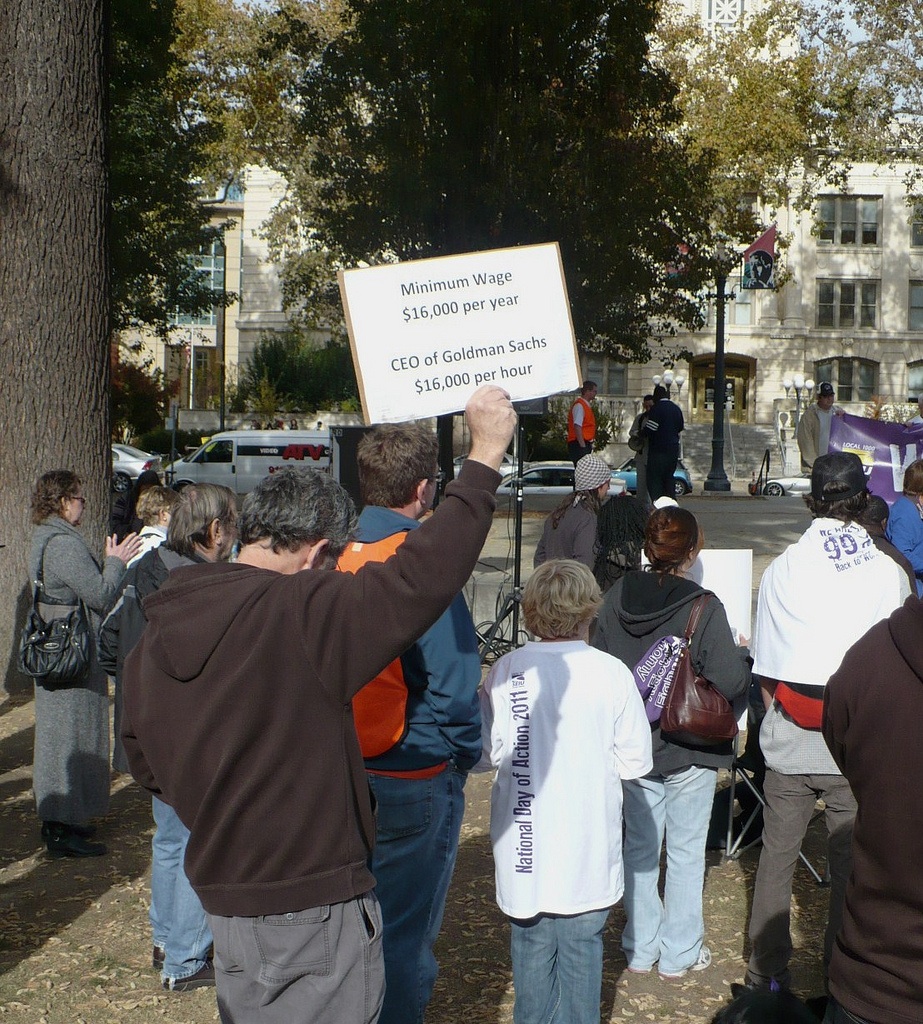
Income Inequality. Image credit: John Kwasnik
Other recent news reports claim that Chinese leaders and their families hold a stupendous amount of between 1 and 4 trillion dollars in offshore tax havens. To put this into perspective, this amounts to something worth between the national economies of South Korea and Germany. This immense fortune contrasts starkly with World Bank figures that (despite the applaudable efforts of the Chinese government) 128 million people in China still live in poverty. If one were to divide that trillion between the poor in China, every single individual would receive over $7000, or enough to keep them above the poverty line of $2 per day for almost ten years. With assets possibly going up to 4 trillion, that could go up to $28.000, or 40 years. Inequality is among the most important concerns of Chinese leaders, as they fear that it may lead to internal tension and the emergence of forces challenging the Communist Party’s legitimacy. But inequality is a growing concern in the United States too. In the CIA’s World Factbook the United States is the 41st most unequal country in the world, even less equal than countries like Russia or Nigeria, which have repeatedly been condemned for their blatant inequality. To illustrate this point, it has been calculated that in 2011, the CEOs of America’s 350 biggest companies earned 231 times the wage of an average private-sector worker. In terms of inequality then, the United States has returned to the state of a developing country.
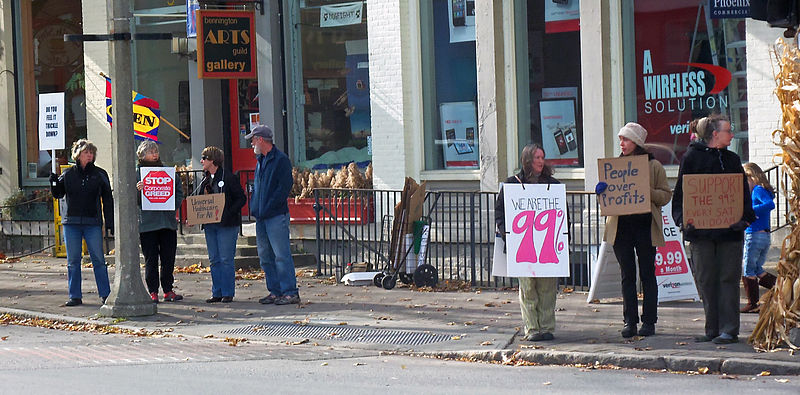
Occupy protesters, Bennington, VT, USA. Image credit: Daniel Case
Of course, if every member of the population would benefit from its country’s growing wealth and would be better off than people in developing countries, one would have less reason to criticize inequality. However, the issue is that this is not the case. The evidence suggests that, among developed countries, the most unequal perform worse on a range of health and social problems than more equal countries. Richard Wilkinson and Kate Pickett, two scholars from the universities of Nottingham and York, have demonstrated that people in unequal countries are more obese and more violent, have more mental illnesses, more teenage mothers and more prisoners, and perform worse in education than more equal countries. [1] Similarly, Amartya Sen, the Nobel Prize-winning economist, also demonstrated that Afro-Americans living in the United States have a shorter life expectancy than the more deprived (in absolute terms) Indians from the province of Kerala. [2] These findings only pertain to developed countries, as there is no denying that for undeveloped or developing countries economic growth is the best recipe to combat poverty and increase quality of life.
However, developed countries have come to a point where material gains no longer have a significant positive effect on quality of life. At this point it is equality that can further enhance quality of life. Wilkinson and Pickett also prove that increased equality does not only help the poor, but that equality has a pervasive effect upon most health and social problems, which translates into better outcomes for almost every member of the population, except for the top 1% or so. Thus, greater equality benefits not only the poor members of a society, but an overwhelming majority.
The last time income inequality was as high as it is at the moment, the world was about to plunge into the Great Depression. Today, the financial crash of 2007/2008 has had similar repercussions throughout the world. In 1933, Americans elected Franklin Roosevelt into office with the mission to rebalance the distribution of income. In 2008, Americans took to the polls again and elected Barack Obama with his pertinent campaign slogan ‘Change’. The two decades following World War II and Roosevelt’s presidency have been a time of great equality. How will Obama’s presidency be remembered? On a global level, we have to ask ourselves the question whether we want to live in a world where 85 individuals own as much wealth as 3.5 billion people. Do we want to live in a world where people die of hunger and lack of sanitary facilities while few others own more money than most economies?
[1] Richard Wilkinson and Kate Pickett, The Spirit Level: Why Equality is Better for Everyone, (London: Penguin Books, 2009)
[2] Amartya Sen, Development as Freedom, (Oxford: Oxford University Press, 1999)
About the Author





