
During the last 2 weeks of the UN climate negotiations, I have been a little critical of Australia’s ambition in combating climate change. However, it iss important to have a more balanced perspective on things. If you ask the Australian government, they will tell you that we are doing a lot, especially when you consider the type of economic growth we have to deal with in the last few years.
According to governmental projections that went into designing our latest Kyoto Protocol target, our economy is set expand by about 3 per cent per year between now and 2020. On top of this, Australia’s population is expected to increase by 12 per cent.
As you can see on the red line on the graph below, Australia is expected to significantly increase our greenhouse gas emissions in the next 10 years if no action is taken.
This is where the government steps in and says, “look at how much we are planning to do!” And I have to give them credit, a 22% reduction on what they like to call “Business As Usual” is pretty impressive, especially for such a developed economy.
But these increases in population and economic growth don’t come anywhere near the increase in greenhouse gas emissions the government has been projecting.
Do you notice that from 2010, the purple line changes to red, and it rises quite dramatically? That’s because from 2010, the government has started projecting that Australia will significantly increase its mining and gas industries. This was highlighted in the government’s recent energy White Paper which shows just how much we’re planning on increasing our fossil fuel industries over the next 20 years.
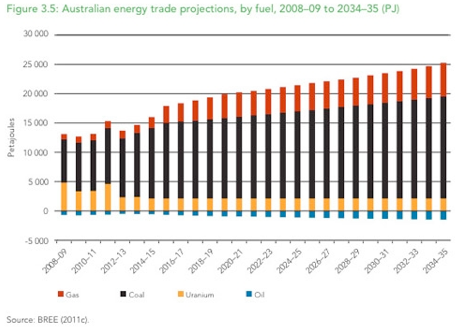
Sure, these increases are mainly going to be shipped off to the emerging economies of Asia. But it takes quite a lot of effort to dig the stuff up and refine or liquefy it. And that’s what’s driving up our so called “Business As Usual” projections.
However, this projection isn’t “Business as Usual” at all. It’s a gigantic increase in fossil fuel extraction and it amounts to considerable increases not only in our own greenhouse gas emissions at home, but would have a ridiculous impact on the global greenhouse budget. As Ben Eltham recently argued:
“Once it is burnt, that carbon will be released into the atmosphere. The same atmosphere that also circulates over Australia.”
At the end of the day, what all of this means is that the fossil fuel industry is apparently here to stay in Australia. While negotiators here have exclaimed that discussions this week have been about “transitioning to a diversified, low carbon economy that is free of fossil fuels”, Australia is transitioning in the wrong direction.
And what makes this worse is that Australian taxpayers are funding it! That’s right, Australian tax payers are some of the biggest investors in the one-way climate highway to hell. According to Oil Change international, the Australian government dished out over $8 billion last year in subsidies to the Fossil Fuel industry.
When it comes to giving money to some of the most vulnerable countries trying to deal with the impacts of climate change, we pledged $204 million. Now this is a pretty good chunk of money, but you have to admit that it’s relatively measly compared to our fossil fuel subsidies.
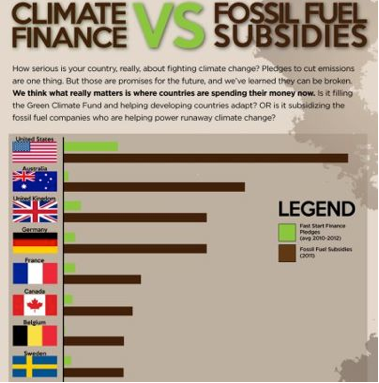
Australia has donated generously to financing adaptation and mitigation projects over the last year, but when you compare this to our ambitious commitment to funding fossil fuels, it falls short in comparison. In fact, Australia has the highest ratio of fossil fuel subsidies compared to climate finance in the developed world. Even higher than the US.
Here in Doha, the lack of finance for developing countries has been one of the key issues holding up negotiations. After a steady stream of funding between 2009 and 2012, developing countries fear that this stream is about to run dry. At the start of the conference, no one in the developed world was willing to put any money on the table for next year, and this has had developing countries spooked ever since.
Earlier today, the UK announced that it will give £1.8bn over the next two years. This is a 40% increase on what they had donated over the last 3 years and the announcement was praised by all. If Australia was to do the same, and announce a 40% increase in our climate finance over the next few years, it could dramatically shape the outcome of this year’s UN climate negotiations.
Considering the growth trajectory the government has predicted, I don’t see why we can’t. If you ask me, it’s time to divert some money away from funding climate change and into climate finance.
About the Author





