
The 11th of November marks the commencement of the 19th Conference of Parties session to the United Nations Framework Convention on Climate Change (UNFCCC) and the 9th session of members to the Kyoto Protocol. The COP moves to Warsaw, Poland this year after the 18th session was held in Doha where very modest results were achieved. However, there is a common agreement amongst the environmental community that COP19 is extremely important in obtaining a legally binding instrument (which will hold all members to reductions as agreed upon in the Durban Platform for Enhanced Action (ADP)) in Paris in 2015, as it marks the stage for accelerated negotiations between member states. A legally binding agreement is now more important than ever. In Doha, there was consensus amongst members that the 2°C increase in global atmospheric conditions would be unavoidable and there was growing fear that there would an increased expansion between committed reduction targets and current carbon emission concentrations.
http://www.youtube.com/watch?v=ZlZZKzJIV0A
BRICS and Climate Change
This widening gap is not the only concern: States which were classified as “Non-Annex I” countries and were not legally bound by Kyoto have undergone extensive expansion in recent years culminating in the formulation of the BRICS (Brazil, Russia, India, China and South Africa) coalition which comprises the major emerging economies and the consequent polluters. The influence of the BRICS coalition may also be strengthened by the formulation of the BRICS development bank which was agreed upon in Durban, South Africa at the 5th BRICS Summit in March 2013. Even though, the workings of the BRICS bank are only to be decided in Brazil in Fortaleza in 2014, the effect of increased finance is uncertain. The rhetoric during the 1st BRICS Summit in Yekaterinburg, Russia was that the BRICS would aim to promote sustainable development however that message has subsequently disappeared from preceding BRICS Summit declarations. The BRICS bank has promised to be different from the Bretton Woods Institutions (World Trade Organisation (WTO), the International Monetary Fund (IMF) and the World Bank) by providing more finance possibilities to the developing world.
It is not a certainty whether increased finance from the BRICS development bank will lead to a stimulation of green economic growth facilitating climate finance for adaptation and renewable energy implementation or whether finance will primarily be used for infrastructure and economic development for more extractive industry of natural resources (business as usual). If the BRICS bank is to be different from other financial institutions that they have condemned so vigorously and called for reforms, they must balance their position between economic development and climate finance. The evidence of whether this will happen is questionable. During the disastrous Copenhagen Summit (COP15) where Chinese, Indian, United States, Brazilian and South African leaders met on the sidelines of the plenary to decline a legally binding agreement in favour of economic growth does not bode well for COP 21 in Paris. There are positive signs though: In mid 2013, China and United States decision makers met and agreed upon measures to curb emissions from vehicles and power stations. There is no doubt that the key to cooperation in climate talks begins with BRICS-US negotiations and in particular China-US relations.
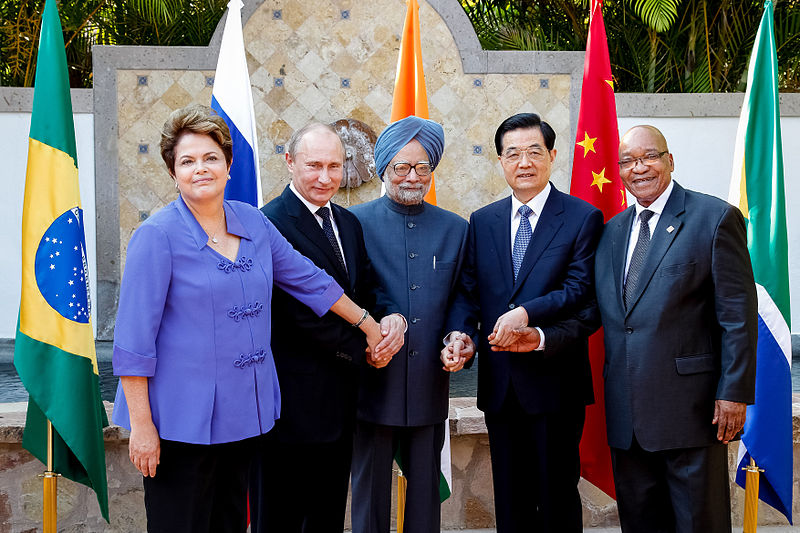
BRICS Leaders 2012. Image credit: Blog do Planalto
Climate Finance
Other expected outcomes include discussions on climate finance which had stalled in Doha. A fund of 100 billion dollars in aid had been committed by 2020 by developed nations to assist climate adaptation however plans on how finance would be mobilised were left unresolved. Furthermore, of the developed nations willing to assist financially only the United Kingdom, Norway and the European Commission have made definitive undertakings. Climate finance has generally been difficult to co-ordinate. In 2009, 30 billion dollars was committed by developed countries however reports from civil society and academics dispute these claims.
In 2013, the use of these funds for climate mitigation and adaptation were to be evaluated, further illustrating the importance of this year’s COP. There is also a need for a formal commitment to the adaptation fund set up under the UNFCCC. The first meeting on long term finance was held in Doha during COP18 and talks are expected to continue in Warsaw. Lastly, the Green Climate Fund (GCF) which was initially discussed in South Africa during COP17 in Durban should be operationalised in Warsaw however this is dependent of the working plan which will be presented to the COP by the GCF.
A major milestone may have lead to more substantial negotiations at COP19 would be the presence of finance ministers of member states. There has long been a dissociation between the finance and environmental sectors at the COP. It is also believed by many experts in civil society and academia that reforms to international fiscal and macroeconomic policy will facilitate greater climate mitigation. However, even if this does materialise, it is doubtful that the public sectors are willing to contribute to climate finance particularly just having come out of the recession. In Warsaw, climate finance from the private sector will possibly be the most likely financial mechanism discussed and the initiatives that need to be implemented to attain this.
Anything concrete?
It is doubtful whether COP19 will cease to be any different from other climate talks with any tangible outcomes being unexpected. This COP is likely to be a small stepping stone as we look to build towards Paris in 2015 and the hope of a legally binding treaty to all members of the COP. There also needs to be firm agreements in the climate finance sector where the GCF needs to be operationilised immediately or cease to be rhetoric. However, the major evaluation of the COP and its underpinning importance for Paris is the relations between China and the United States. If the two biggest polluters can foster positive climate talks, surely Paris will be a success.
About the Author





