
In a series of much criticised decisions, Hungary’s governing Fidesz party embarked upon a quest to revolutionise virtually all areas of the country’s political sphere, most recently drawing international attention by proposing the world’s first internet tax.
Prime minister Viktor Orban’s original proposal would have charged the private user 150 forints (£0.40; 0.50 euros; $0.60) per gigabyte of data traffic while more was imposed upon corporate bodies. The tax was to be implemented from 2015, with the aim to balance the country’s troubled finances.
This most unusual of proposals has been through major developments since last week due to unprecedented reactions from international and domestic critics. Upon facing the unusual sight of 40,000 people marching on the streets of Budapest and some other major cities, Fidesz announced to cap the tax on 700 forints for private users and 5000 forints for companies.
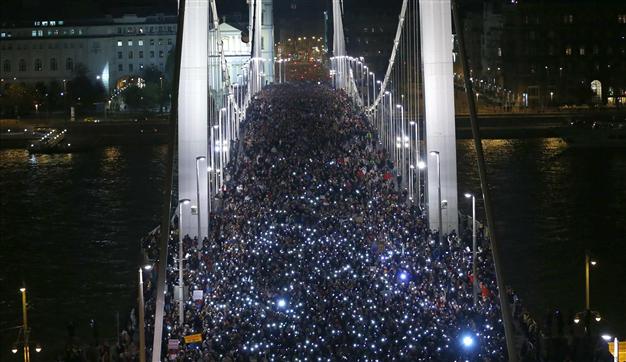
Thousands of Hungarians march across the Elisabeth Bridge during a protest against new tax on Internet. Image Credit: hurriyetdailynews
This raised criticism about Orban’s true plans with the tax. To better understand their reasons to doubt, we must put these events into political context:
Viktor Orban’s Fidesz party won their second term of governance in April 2014, despite their widely criticised undemocratic style of exercising power. Yet, Orban’s party enjoys rampant popularity – especially among the elderly – due to populist communication and Orban’s charisma.
Incidentally, the recent tax proposal happens to coincide with the US government’s decision to issue entry bans on certain Hungarian officials in response to a corruption scandal and the country’s semi-open support ties to Russian President Vladimir Putin.
Several details about the tax proposal also appear flawed: the report on which it is based vastly underestimates the country’s internet usage, as well as the eventual funds generated by the tax itself. Not only however the report is illogical but as previous examples show (Nicholas Sarkozy and Bill Clinton both attempted to implement a ‘bit tax’) the actualisation is impossible to carry out unless several nations are involved at once. Not surprising therefore, that critical voices appear to question Orban’s aims with the plan.
Hungarian media organizations deemed the plan a mere communicational strategy, which was never planned to be implemented in its original form. It was instead aimed to quieten democracy advocates criticising the party for their disregard of public opinion.
Orban’s response gave rise to more suspicion:
“If the people do not just dislike something, but think it is irrational, then it should not be done”, the Prime Minister expressed in an interview, which is a most surprising response from a leader who is known to alter entire Constitutional sections in a matter of days.
Corruption Scandal
It is also important to bear in mind the volume of another controversy, namely the corruption scandal. Some sources seem to firmly believe that the predictably unpopular proposal’s purpose is to draw attention from the scandal and its international reception.
Whether these accusations stand their ground may be debatable but one trend behind the events is even more worrying: the Orban government’s complete disregard of basic democratic principles, and their inclination to push the country further away from Europe (and the West, as a whole) by a much criticised political allegiance with Moscow.
The internet arguably is an alternative information source, until now, uncontrolled by the government. If the EU and international powers do not press the Orban administration towards more democratic measures, more sanctions and tighter Moscow ties may come, further distancing the country from the rest of Europe.
About the Author






[…] In a series of much criticised decisions, Hungary's governing Fidesz party embarked upon a quest to revolutionise virtually all areas of the country's political sphere, most recently drawing international attention by proposing the world's first… […]