
The fifth BRICS Summit ended on Wednesday afternoon in Durban, South Africa. A few key announcements were made on bilateral agreements between the BRICS members. The leaders of BRICS ratified two major deals: namely a BRICS multi-lateral infrastructure co-financing agreement for Africa, in particular, and a BRICS multi-lateral cooperation and co-financing agreement for sustainable development. The acknowledgement of issues such as “sustainable development” and the “green economy” illustrates that the BRICS countries acknowledge that the environment and climate change are key issues on the global stage. One of the most outstanding outcomes of the summit was the formation of the 25-member BRICS business council.
The BRICS business council will comprise of five members each from each BRICS member country. The objectives that would hope to be achieved by the council would be enhancing trade relations, strengthening of business, technology transfer in skills development, green economy development, manufacturing and of course, industry. President Jacob Zuma of South Africa was positive about the outcome of the formation of the BRICS business council, saying that the council represented “a platform to strengthen and promote economic, trade, business and investment ties between the business communities of the five BRICS countries”. South Africa’s Patrice Motsepe who is the chair of African Rainbow Minerals was named as chair of the BRICS business council with the chair rotational on an annual basis based on the country hosting the BRICS summit. Motesepe has stated that the council will focus on job creation and the improvement of living standards. There was also recognition that there was a need for creation of women-owned, youth-owned and micro-enterprise ventures in the BRICS. The formation of this BRICS business council cannot be understated as the potential start of what could be a shift in the powers of the global economy. Over the last decade, the GDP of the BRICS members combined has increased from $3 billion to $13 billion. FDIs (Foreign Direct Investment) have tripled over the past decade too and trade between the BRICS has increased from $27 billion to $282 billion (2002-2012).
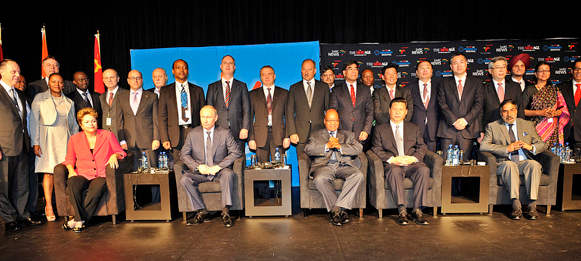
Presidents from Brazil, Russia, South Africa, China and India (Indian representative for the Indian Prime minister) at the 5th BRICS Summit in Durban, South Africa (Photo adapted from the official BRICS5 website).
There has also been substantial movement of the currency fund where a pool of financial reserves will be created for support to the BRICS. This now mobilizes the initial idea that came into being on the sidelines of the G20 in Mexico last year. The currency fund has been described as “the establishment of a self-managed contingent reserve arrangement would have a positive precautionary effect, help BRICS countries forestall short-term liquidity pressures, provide mutual support and further strengthen financial stability.” The agreement of the fund is estimated to be $100 billion dollars with China contributing $41 billion, while India, Russia and Brazil will contribute $18 billion dollars and South Africa, $5 billion. Unfortunately, details were not outlined of exactly how the currency fund will operate.
On the BRICS Development Bank front, leaders came to a consensus to establish the bank and gave permission to their financial ministers to start negotiations on the size, governance, structure, location and operating protocol. This should be worked on during the next year before the start of the 6th BRICS Summit in Brazil next year. The success of the Summit cannot be summarized better than by the words of South African finance Minister, Pravin Gordhan, “The fact that in one year you can initiate an idea and get it to a point where you’ve got five different countries saying let’s establish it and having established its feasibility and viability is phenomenal progress which you rarely see around the world”.
BRICS, definitely starting to look like a bloc…
About the Author





