
We are living in startling times in the European Union. For the past three years, Angela Merkel has used Germany’s large voting power within European institutions to force through an agenda of collective impoverishment for the South of Europe. This destructive policy has led hundreds of thousands to migrate from Portugal, Greece, Spain and other austerity-crippled countries. Meanwhile, the coordinated European dive into austerity has imploded demand and led to the stagnation of the European economy, undeniably the world’s largest, by aggregate.
In spite of extraordinarily poor economic outcomes, the policy of austerity is still passionately defended by many, including the governments of bailed-out countries. Portuguese Finance Minister, Vítor Gaspar, a technocrat with a remarkable CV within Eurobureacracy, was recently called a Troika finance minister by Irish political commentators, for the uncompromising way with which he puts the austerity agenda above his own country’s interests. It is remarkable how European leaders have learnt with the late Margaret Thatcher to be unflinching in the face of agony and suffering. Angela Merkel this week was reported as saying that “We know that there will have to be victims/sacrifices in many countries, but I believe that in the long term we’ll have to have a growth strategy without always having to pile on debt.” This Darwinistic view, that pain is necessary to reignite confidence and growth in Europe, is not only morally repugnant, but also and more fundamentally, economically incorrect.
The austerity forced by European leaders on their populations was backed by an academic study by former IMF Chief Economist, Carmen Reinhart, and Kenneth Rogoff. This study claimed to prove that high levels of public debt severely crippled real GDP growth, pointing out the 90% debt-to-GDP ratio as a threshold after which growth slows down by about 1%. These conclusions were exactly the justification sought by the neo-liberal establishment to justify the redistribution of wealth from the poorest to the wealthiest in society, from the South to the North of Europe. Time and again this study has been cited by leaders and opinion-makers to attempt to academically strong-arm opponents of austerity. However, a new study by economists at the University of Massachusetts, Amherst shows that selective exclusion of data, unconventional weighting and a coding error means that the correlation between high-public-debt and growth is not nearly as significant. As if arguments that correlation between public debt and low growth did not provide causation weren’t good enough, there is now authoritative academic foundation on which to completely reject the Reinhart-Rogoff study that was so decisive in moving the world towards austerity.
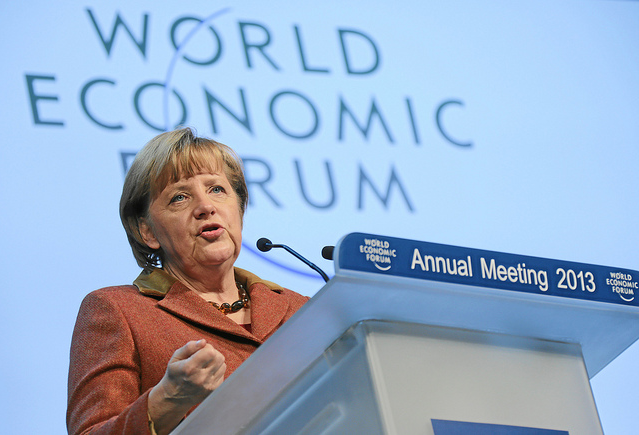
Angela Merkel gives a special address at the World Economic Forum in Davos. Image Credit: WEF/Flickr
The idea that austerity cannot work is not new. Paul Krugman has been a constant critic of austerity ever since we first dared to make that mistake. In a recent blog post, he warned us of a larger picture: an evident urge to seek excuses to inflict pain. Krugman points out a 2012 OECD working paper that first offered an econometric critique of the Reinhart-Rogoff fiasco, showing that while there was a negative correlation between growth and public-debt, its effects kicked in far earlier. This study didn’t want to be overambitious in completely rejecting the 90% threshold that the global neo-liberal establishment has put such effort into promoting, but it was damning in demanding that more research be done before we accept the now discredited Reinhart-Rogoff hypothesis. Likewise damning for austerity was IMF Chief Economist Olivier Blanchard and Daniel Leigh’s renown papers on fiscal multipliers, which recalculated the GDP change expected for every currency unit of austerity, finding these to be several times greater than those earlier predicted. This study was the inescapable acceptance of reality – that austerity hurts growth, not just a little bit, but a lot. So much so that it has proved ineffective, in all European countries, as a policy to reduce deficits, with Greece and Portugal being repeat offenders of missing budget targets, due to tax revenues falling at a rate far faster than was predicted.
While austerity has unquestionably failed as a method to reduce the levels of public debt, the question remains whether or not the current level of debt is sustainable. Servicing debt is now a major budget item for many European economies, and the economic and fiscal outlook suggests that it will continue to be so for a long time. In fact, Portugal, for instance, has now achieved a positive structural primary budget balance, meaning that its deficit (over 6% of its fast-shrinking GDP) is entirely owed to servicing debt and the recession that the government has imposed on the country through their zeal for going above and beyond that requested by the Troika in austerity. This has led debt restructuring to become the consensus in all the Portuguese civil society but the government. Even conservative politicians and economists have come out in favour of abandoning austerity and renegotiating the terms of the agreement signed with the ECB, EU and IMF ‘troika’.

Tough austerity measures have been controversial around Europe. Image credit: Images Money/Flickr
However, many are still skeptical of debt restructuring. A sensible middle-of-the-road policy between default and austerity, restructuring has been pursued countless times by advanced economies with few repercussions on future financing. In fact, it is a scenario welcomed by both Rogoff and Reinhart, who have claimed that when debts get to this level, they historically need some kind of negotiation with creditors. Critics of restructuring argue that it is a partial default, that will shatter trust in public finance, and harm banks’ balance sheets. Truth of the matter is, a restructuring represents part of the risk for which debtors pay interest on their loans. As Slavoj Zizek pointed out in his recent article in the New Statesman, too often we have been too scared to let the powerful and wealthy endure the consequences of their risks, while we have been too willing to let the poor take on all the costs for these risks. Restructuring is nothing more than being realistic and responsible, and suggest that it is better to pay back some of the debt, than none of it – which is just as much debt as we’ll be able to pay if we continue to blast our way through the real economy with toxic austerity. Of course, in the short run, banks will be hurt by a restructuring. There’s no going round that. But haven’t we already footed enough of the bill for their failure already? According to Mark Blyth, we have lost somewhere between $3 and $13 trillion in bailing out the banks, and in our efforts to reduce some of the public debt we have gained for doing so. Blyth has attributed the pan-European sovereign debt crisis not to government inefficiency or excess spending, but to a common denominator that affects all bailed-out economies – banks and bank failure. Where then is the personal responsibility that the Right speak so much about? When have they been held responsible for their mess?
We have socialised the costs of bank failure, with particular incidence on the poorest, who have suffered the most with cuts to welfare, healthcare, and education. The result has been disastrous for society, and it has been disastrous for the economy. It hasn’t even worked in bringing down deficits and culling debt! Helping the banks rehab by crippling the remainder of the economy has proved ‘surprisingly’ ineffective. Well now it is time that we privatise the costs not only of the bank’s failures, but of the government’s failure in dealing with this mess. It is time we restructure the debt, and go back to the business of delivering sustainable growth and equitable prosperity again.
About the Author






[…] Lagarde) and the European Commission (through Jose Manuel Durao Barroso) recently admitted, austerity measures didn’t work and “perhaps we should have tried another approach“. But it seems that the […]
[…] This article was originally published in the International Political Forum, the home of politically engaged young people across the world. You can find the original article here. […]