
Ahead of a key universal suffrage vote, the failure of Hong Kong’s pro-democracy parties to capitalize on Beijing’s unpopularity does not bode well
“For the serious failure in this election I have to accept full political responsibility as the chairman of the Democratic Party.” Bowing to television cameras, Albert Ho gave this heartfelt speech as he resigned this morning following a catastrophic defeat for his party in Hong Kong’s Legislative Council elections, which were held on Sunday.
The election resulted in 27 seats out of 70 for the pan-democrats in the Legislative Council. Losing half of their seats in the so-called ‘geographical constituencies’, the Democratic party, with four seats take second place in the pro-democracy faction, which will now be led by the Civic party’s five directly elected deputies.
This vote took place against a backdrop of protest. A series of policy missteps by the new Chief Executive C. Y. Leung culminated in the weeks long demonstrations and hunger strikes over proposed new patriotic education classes set by the mainland. Mr. Leung caved just before the election, saying that the class curriculum, which portrays democracy as “chaos”; extol the virtues of one-party rule; and glosses over the Tiananmen Square massacre; would not be compulsory.
A relatively high turnout of 58%, largely attributed to parents concerned about their children’s education, was expected to benefit pro-democracy parties. But the result from 1.7 million voters showed a steady split of 21/19 deputies for democracy/Beijing parties, of the 40 directly elected seats up for grabs.
Overall the Beijing faction retain their gerrymandered majority of 43 seats, thanks to 30 functional constituencies, where voting is reserved for member of the business community and other special interests.
The importance of these results lies in the bargaining power it gives the respective factions to shape the first direct election for the Chief Executive in 2017, who is currently appointed by a pro-Beijing committee. Whilst the pan-democrats have just retained their vital minority to veto constitutional changes expected to be tabled by the government on universal suffrage, the splitting of the vote has left a fractious and divisive group of parties to defend Hong Kong’s democracy.
These parties have already proved that they struggle to coordinate their actions against the Beijing faction. An attempt in 2010 to trigger a de facto referendum on abolishing functional constituencies foundered when only five pan-democrats resigned to stand in by-elections. The Democratic and Civic parties refused to participate, leaving them at odds with the League of Social Democrats.
And whilst radical deputies such as ‘Long Hair’ Leung have proved popular with some voters, the pro-establishment Democratic Alliance for the Betterment and Progress of Hong Kong has maintained its crushing lead in the popular and functional vote.
So the pan-democrats will not hold the initiative in crafting the necessary constitutional amendments which will determine nature and breadth of suffrage in 2017. Whilst they can block the worst excesses of an establishment desperate to hold elections with pre-determined outcomes, thanks to the failure of democrats in this vote they and the public will have to be satisfied with a Beijing directed electoral system. For those who watched the Chinese government dismantle Governor Patten’s voting system for the 1995 Legislative Council, a vote which saw a fully elected chamber through a franchise extended to almost every single man and women in the territory, little hope of a fair system can remain.
The anger of Hongkongers against what they see as mainland encroachment on their freedoms did not translate into the overwhelming victory expected for pan-democrats. Nevertheless, the vitality, strength and passion of recent demonstrations has been able to defeat government plans, without the help of politicians. If Hong Kong is to obtain true democracy in the coming 2017 Chief Executive election and not be disappointed by another delay by the Chinese government, it must rely on the spirit of public disobedience and protest that has already shook Beijing into submission, rather than a political class which is failing its constituents.
No-one knows what to expect from the Chinese government in 2017, but with civil disobedience and protest lending strength to pro-democracy arguments, hope for universal suffrage may not be in danger of disappearing. Not yet.
Image: Kin Cheung/Associated Press
About the Author



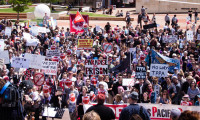


Now that more than half a year has gone by, the fight for full democracy is starting to gain momentum among the general public. A carefully-planned act of civil disobedience , “Occupy Central with Love and Peace”, was proposed by Associate Professor of law Benny Tai Yiu Ting of the University of Hong Kong in January.
As a new IPF contributor from Hong Kong, I will be covering this continuous fight for democracy during this critical time. Stay tuned!
[…] Related: Protest vote? Hong Kong Election Analysis […]