
I have witnessed, on numerous occasions, New York Police Department (NYPD) officers in plainclothes stopping and frisking African-American and Latino youth on the street corners and subway stations of East Harlem, where I have lived for three years. Handcuffed and sat down on the station benches or on the sidewalk, these youth–who usually wear hoodies or baggy jeans– put their heads down in a sign of shame as passengers and passers-by look at them with curiosity. Meanwhile, agents use their walkie-talkies hoping that they have caught a potential criminal.
Such humiliating acts have met a challenge. On August 7, 2013, the New York Supreme Court announced that the New York City Policy Department (NYPD) agreed to clear its database of people who were stopped under the controversial 10-year-long stop-and-frisk practice but whose alleged criminal charges were not proven. The much criticized stop-and-frisk is known for stopping, questioning, and searching men NYPD agents consider suspicious of crime activities, and the defenders of this practice say it has helped deter crime.
Further, on August 12, Federal Judge Shira A. Scheindlin found that such practices violated the constitution’s Fourth Amendment, which protects against unreasonable searches and seizures by the government, as well as violations with the 14th Amendment’s equal protection clause. The judge also called for a federal monitor to oversee broad reforms. That same day, Attorney General Eric Holder in a speech to the American Bar Association said our judicial system needs sweeping and systemic changes, and stated that people of color often face harsher punishments than their peers.
Erasing of data information from innocent men and the federal ruling represent a giant leap toward halting the negative impact indiscriminating stop-and-frisk practice poses over people of African-American or Hispanic descent who live in the Big Apple. Nevertheless, these landmark decisions do not mean an end to stop-and-frisk practices now that Mayor Bloomberg pledged to repeal the federal ruling, thus the road to fix a criminal justice that is fair to communities of color is a treacherous one – but the fight for a fair system must go on.
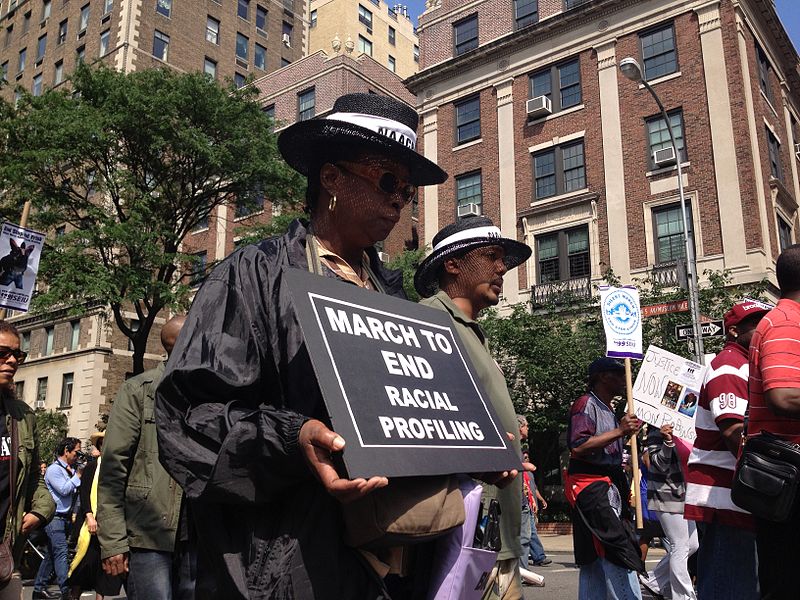
Veiled demonstrators at a march against racially disproportionate policing in New York City. Image Credit: longislandwins
Stop-and-frisk practices have targeted communities of color, mostly under the suspicions of weapons possession. According to a late 2011 report by the NYPD, nine out of 10 people stopped and frisked were African-American or Hispanic. Of the 685,724 stops made in 2011, 53 percent of those interrogated were African-American, while 34 percent were Hispanic, 3 percent Asian, and 9 percent non-Hispanic white. The New York population in 2011 was 23.4 percent black, 29.4 Hispanic, 12.9 percent Asian, and 34.3 percent non-Hispanic white. In addition to my neighborhood, low-income localities in Brooklyn and the Bronx, for example, are the usual target of NYPD’s stop-and-frisk tactics. Brooklyn’s 75th Precinct, where predominantly African-American and Hispanic neighborhoods are located, registered 31,100 stop-and-frisk incidents, the largest in the five boroughs. Ninety-seven percent of these cases involved either black or Hispanic, and more than 80 percent of the precinct’s population is comprised of these two groups. Even in predominantly white neighborhoods, men of color are prone to stops. In more affluent neighborhoods in Brooklyn like Park Slope, for example, black and Latino New Yorkers made up 24 percent of its population in 2011, yet 79 percent of stops were attributed to these groups.
Advocacy groups such as the New York Civil Liberties Union (NYCLU) has managed to demystify the benefits stop-and-frisk activities have brought to reduce crime. While violent crimes fell in New York from 2001 to 2010 by 29 percent, other large metropolitan areas have seen their crime rates plummet without the reliance of stop-and-frisk initiatives. Los Angeles, for example, saw a 59 percent crime drop, 59 percent in New Orleans, and 37 percent in Baltimore. Another staggering statistic NYCLU shares is that guns – the main reason of all stops and possible searches – are found in less than 0.2 percent of all confiscations. NYCLU added that on March 2013 Mayor Bloomberg reached its 5 millionth stop-and-frisk.
What’s really striking about stop-and-frisk practices is that about 90 percent of stopped and frisked New Yorkers are proved innocent. The increasing stop-and- frisk activities against our communities are oftentimes a byproduct of a distorted image of communities of color in the media. In the U.S. the sad legacy of shows like COPS, video games, music videos, and the constant TV news coverage of African-American and Latino communities that espouse them with criminality, unemployment and poverty eclipse other positive roles of men of color. Many of them are fathers, college students, professionals, or male immigrants who seek a better life in this country. In other words, men who enrich the very fabric of American society.
In addition to distorted images of men of color, the current broken criminal system and the lack of gun control have proved to be a dangerous concoction to these communities. The Trayvon Martin case outcome, for example, is also a wake-up call that some state and city laws need to be revised in order to guarantee a fair criminal justice system to communities of color. It’d serve Mayor Bloomberg well to assess the negative impact of stop-and-frisk practices. It’s time to break lingering negative perceptions of these racial and ethnic groups in order to offer a chance to improve their well-being. We may not eradicate racism and prejudice all at once in our society, but by amending our criminal justice system it will help other metropolitan areas desist of adopting copycat stop-and-frisk practices and ensure fair justice and treatment.
About the Author





