
As the United Nations voted through the long awaited Arms Trade Treaty in early April, the United States is still unable to achieve small amendments to their gun bill. President Obama expressed his disappointment, calling April 18th when the proposal was voted down “a pretty shameful day for Washington.”
In December 2012, 20-year old Adam Lanza shot 26 people dead, 20 of which were children between the ages 5 and 10, at Sandy Hook Elementary School in Connecticut. In the aftermath of this event, the President vowed to change the country’s liberal fire arm legislation. At yet another tragedy cause by gun violence, he declared that “as a country we have been through this too many times.” But the fact that the right to carry arms is a constitutional right in the US is an argument with a lot of weight. Along with the National Rifle Association’s claim that limiting access to guns would not in fact decrease gun violence, proposals like this one are difficult to pass.
This is not a new issue for American society. Perhaps most famously addressed by Michael Moore in his 2002 documentary Bowling for Columbine, easy access to guns and firearms have caused tragedy after tragedy in American society. The film’s title is mocking the somewhat bizarre attempts to blame the 1999 massacre in Columbine High School on other things, such as violent video games and provocative artists like Marilyn Manson, rather than gun legislation. Since the killers Eric Harris and Dylan Klebold attended a bowling class right before they opened fire in the school that day, Moore is suggesting that this is just as likely to have caused the massacre. As a counterargument he demonstrates how easy it is to access firearms: in one town, it is a simple as opening a bank account. Ammunition can be found in the common superstore K-Mart.
In March 1996, the Scottish town Dunblane was shaken by a similar event. Local 42-year old Thomas Hamilton went on a shooting spree in the gymnasium of Dunblane Primary School where a class of primary ones where having a PE lesson. He killed 16 children, all under the age of 6, along with their head teacher. Another 11 children and 3 adults were injured. Following this event, families of victims and other locals in Dunblane started lobbying for tighter gun control in what they named the Snowdrop Campaign. By October 1996 they had achieved their first goal: a government proposal including a complete ban of handguns in the UK, which made this one of the tightest gun legislations in the world.
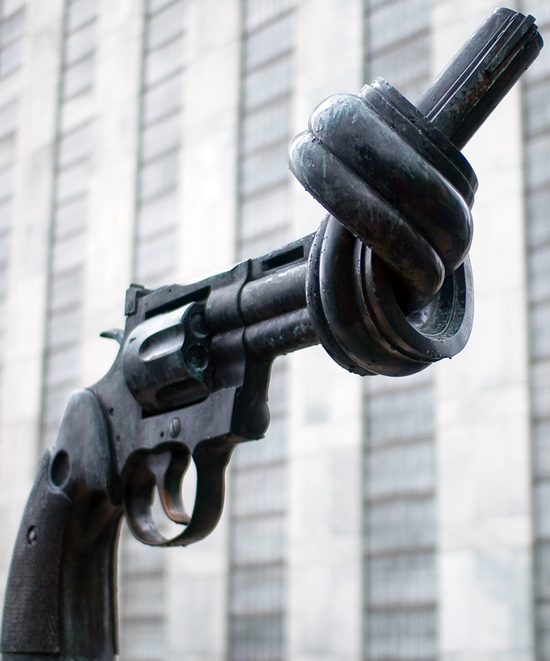
Image Credit: Amnesty UK
This is where the stories differ: the proposal was passed, and Britain has not seen another tragedy caused by guns or other firearms until 2010, 14 years later. The American president was clearly hoping that Sandy Hook 2012 would come to be a similar turning point for the US. But it has proved difficult to even get this process started. The proposed American legislation that was rejected by the Senate this week was nowhere near as rigid as the British one adopted in the 90s. It simply proposed extended background checks on buyers of firearms; efforts to ban heavier arms, such as machine guns and assault weapons, have already been abandoned due to the severe political opposition. Needless to say, a complete prohibition of handguns is not even on the agenda.
American society is one where guns are seen as a means of protection. Going back to the time of independence, when the right to carry arms was put down in the constitution, it no doubts had its benefits. But today it makes for great irony: the guns that are supposed to keep society safe are instead creating more terror. With statistics revealing that there are nearly 90 guns per 100 people in the US, the large number of tragedies caused by guns cannot be a coincidence. A Batman screening in Colorado, a shopping mall in Oregon and an elementary school in Connecticut, all in the same year. Yet the notion persists in American society: we need guns for protection, even when guns are what we actually need to protect ourselves from. The height of this irony came when the NRA declared that more guns, rather than the opposite, is the solution to gun violence. “The only thing that stops a bad guy with a gun is a good guy with a gun,” said CEO Wayne LaPierre shortly after the Sandy Hook shootings. The suggestion was to put armed guards in all schools to protect the children from these attacks. Guns for protection against guns.
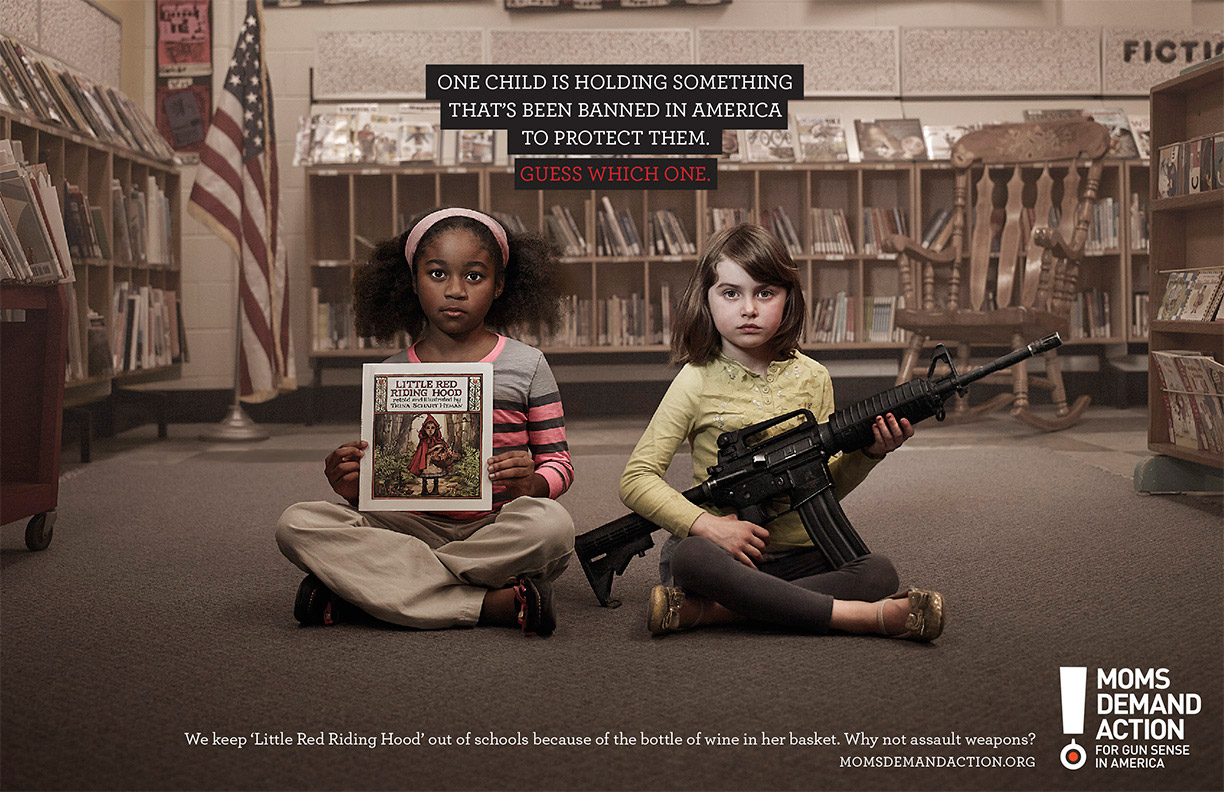
Image: Part of a PSA series from Moms Demand Action.
Coming from the world’s largest gun lobbyist, this is perhaps less surprising than it should be. But even if we overlook the obvious danger in putting weapons in an environment where children are running and playing, this argument is full of disturbing connotations. It values guns over people, and it promotes violence and threats towards the so called “bad guys” as a solution. It tells us that the bad guy himself is the problem, rather than the gun he is holding. Accepting this logic for the sake of argument still leaves us with an obvious objection. If a good guy with a gun is the only way to stop a bad guy with a gun, surely a bad guy with no gun is the preferable option.
Read Also: Guns Blazing: Joe Biden’s Demilitarisation of America’s Citizens
About the Author






1. You’re forgetting the Crumbria shootings where a lone gun man killed 12 people in the UK in 2010. So Britain has seen at least one more large massacre since the gun laws. This is less than the US but is more accurate than your statement that none have happened.
2. Before 1996 and the gun regulations, the UK had 12 documented ‘massacres’ in the last century wherein at least 3 people died and at least one person was injured (to be fair the largest shooting-only massacre was 16 people killed and the most ever injured was 17).
2a. The second largest massacre of 14 people (and the most people injured at 17) was actually done by the British Military in what we know as Bloody Sunday in 1972. Yet some people want the government to be the only ones with guns?
2b. The 12 massacres include bombings and grenade attacks such as the Conventry Blitz and Poppy Day bombings. Such attacks generally have larger death rates given the power of a bomb compared to a single bullet.
3. Gun related deaths (different from gun violence) in the UK has decreased but knife violence/killings and blunt object killings have increased. In addition, blunt force trauma killings vastly outnumber gun deaths in nearly all countries regardless of their firearms laws. You are more likely to be killed with a baseball bat than a gun, even in the US.
3. Mexico has an outright gun ban. No civilian may own a gun. Yet they have some of the highest gun murder rates. So to say that gun laws = less gun deaths isn’t entirely factual. Which leads to….
4. The research on the association between gun regulations and gun violence are shoddy at best. Correlation does not equal causation therefore we cannot automatically assume that stricter gun laws means less gun crime. By that same token we cannot empirically state that more guns out there means less crime. There have been some cases in the US that have indicated that cities with concealed carry have less gun violence and deaths but all the same we can’t just assume that’s because of the concealed carry. There are many factors at play and to create laws based on feelings of “but we have to do something” or “think of the children” is a dangerous prescient to set for future laws.
5. Culture is often overlooked. You can’t legislate away racism, stupidity, religion, atheism, languages, ideas, or mental health problems. Segue: Homosexuality is still unfortunately banned in many countries but that doesn’t mean people are suddenly all straight. But in any case, my point is gun-law advocates are so quick to jump to the surface cause that they are ignoring the roots. Mental health, lack of education, indifference to human life, feelings of helplessness, perhaps people driven by their economic status, hatred between people, gang warfare. Dealing with the underlying cultural issues is the much greater task. Band-aid solutions will not work. Teach people to respect firearms rather than fear them. In addition, teach the value of human life. It’s a lesson we often forget and one which firearms can teach us. It certainly taught me that life is fragile but the power to protect or take it is in my hands as an individual. As the saying goes ‘with great power comes great responsibility.”
So yes, it is the bad guy who is the problem. A gun is an object, a tool. It cannot act on its own. People commit crimes with guns. Not the other way around.
6. Finally, how can someone claim a moral high ground when they are trying to control what others can and cannot own? Sure you can care about people, but most people have empathy and do care for their fellow man and wouldn’t dream of hurting them. A lot of those people also think that others should not be dictating what they can and cannot own. If these objects are being banned because of their potential to cause harm if used by a person in an unsafe manner than I doubt many things would be legal. As mentioned, more people die of baseball bats, knife wounds, and car accidents. Yes the primary purpose of a gun is to cause harm but that may also be in the case of defense. If an attacker knows you have the power to stop them, they may think twice of robbing your home or your person or harming you. Neither men or women should feel targeted but it’s great to know that when push comes to shove the 90lbs can take down the 300lbs attacker.
Making all citizens guilty before a crime has been committed helps no one and sets a nasty president that others will exploit to limit what you can own. That photo of the two children is right. One of those things is not allowed in the country to “protect children” but both those things should be allowed to be owned by people. We don’t like censorship so why are we happy to be censored on what we can purchase when we find it convenient? Freedom isn’t about convenience. It is a matter of principle and goes beyond guns. The government (ie other people) should not be telling you what you can and cannot own be it a book, a car, a video, a kinder surprise, or a gun.
A bad guy with no gun is great, but it cannot come at the expense of others being the bad guy and forcing the good guy to relinquish his.
1. I can only apologise for that, I will make sure it gets changed. I do think my main argument remains though, with 14 years in between these two events.
2. I don’t see how my want for gun legislation is the same as saying only governments should carry arms. The British police force does not carry guns, and I think that is how it should be. The British Military obviously does carry arms, but it is hard to argue that they shouldn’t without saying that there shouldn’t be a military at all.
3. I have never claimed that Britain is free from violence. I’ve lived in Glasgow which I believe is the worst city in Europe when it comes to knife violence and stabbing. Bombings is of course also a problem, like the examples you bring up. But I think this is beside the point. All I’m saying here is that there is too much gun violence in America, and I think it can be decreased by legislation. The example of Mexico is also slightly off from the argument. Most of the violence there is caused by drug cartels, criminal gangs and the police/military/government who are trying to combat this with more violence. I am arguing that easy gun access is a problem, and I think it’s safe to say that all these groups in Mexico have guns regardless of what the law says.
4. I disagree. Look at someone like Adam Lanza. He suffered from autism and took medication for mood swings. If his family had not kept guns in the house, the outcome could have been very different. Same with Thomas Hamilton in Dunblane. He held a grudge against the school for sacking him, and because he was able to just go and buy some handguns, that is what he chose to do with his anger. Gun bans and background checks could have stopped both of them. That is not to say that it couldn’t have happened anyway, and of course there’s no way to prove it, but I really do think it’s worth making it that little bit more difficult.
5. I agree. Again, Adam Lanza sparked debate about mental health issues, because he clearly wasn’t given the help he was needed. But addressing the deeper issues is going to take much longer than preventing easy access to guns. I am not claiming that gun legislation will eliminate all violence. I am simply saying that if we limit the means for people to inflict this type of extreme harm, it will be a step in the right direction.
6. I don’t believe in using your own rights as an excuse to inflict harm on others. When human rights conflict with each other, we have to weigh the potential outcomes of breach against each other. I don’t believe my right to own whatever I want is worth more than someone else’s right to live, because guns are made to kill and to harm and there’s no way around that. In my opinion nobody should be allowed to own weapons, but I don’t expect to ever see a society where this is the case. Like you say, guns are kept for security and self protection. I think this is a version of the security dilemma: we need to keep guns because other people have guns, and they might use them against us. It does make sense, but it’s also unbelievably bizarre to think that I need a gun in order to not get shot. For this reason I want to make it more difficult for everyone to access them.
“It tells us that the bad guy himself is the problem, rather than the gun he is holding.”
You are absolutely right. Similarly, spoons make people fat. Furthermore, banning weapons will ensure that no bad guy can gain access to one anymore, because the black market will just disappear, so people will just have to learn to live without having to kill others.
What I meant by that quote there is that we should protect people rather than their right to own a gun. I did not mean that we shouldn’t address the underlying causes of violence. (But of course you’re right, and a spoon is just as dangerous.) It will never be impossible to find guns, but if it’s more difficult and less acceptable I truly believe fewer of these tragedies will happen.
Shut up Nick.