
If 2014 was an historic year for climate change, where the world dug deeper into its resolve not to collectively fight it. Yet despite the worsening snowstorms and stranded polar bears, more extreme climate activity, and the painful droughts, tsunamis, and heat, there were a few shining policy gems in the midst of the ever-increasing smog.
On a global scale, nothing gave ‘Justin Bieber’ headlines more of a run for their money than the U.S.-China deal on reducing carbon emissions, or the massive drop in oil prices as oil production surged. The U.S.-China Joint Announcement on Climate Change stated CO2 targets that both nations would strive to achieve, commenced the peer-review of energy inefficient fossil fuel subsidies, and expanded bilateral cooperation regarding technological development of clean energy technologies and green goods, amongst other things. The agreement, coming in only months after President Barack Obama’s historic revamp of domestic environment policy, solidified the commitment of the two largest CO2 emitters and the two nations most hesitant to sign global climate treaties.
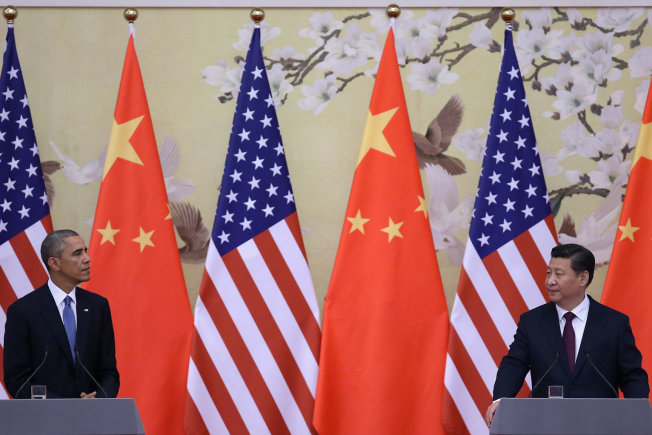
Barack Obama, left, and Chinese President Xi Jinping attend a press conference on climate change at the Great Hall of People in Beijing. Image Source: http://bit.ly/1B9YwZ4
Other important positive developments included President Obama’s executive action to reduce carbon emissions from power plants, which was the first major national action that showed America’s commitment to climate change in a manner that could bring it credible global leadership on the issue. Japan restarted two of its 48 nuclear power plants after a hefty revamp of nuclear safety – thus increasing clean energy output. Germany solidified its decision to expand renewable energy sources, while unfortunately continuing its commitment to shutting down its nuclear energy sector.
Though these are undoubtedly a step in the right direction, there are still major challenges to fighting climate change. The drop in oil prices across the world, because of increased oil production, is making environmentally friendly energy less competitive, and making large SUVs more friendly. As natural gas production through the usage of hydraulic fracturing increases, and the newly elected American Republican Senate and House prepare to pass legislature allowing the construction of the Keystone XL Pipeline that is to allow the shipment of oil from Artic tar sands in Canada, the fight for cleaner energy policies is about to become much tougher. These shifting sands are going to affect the U.S.’s energy policies as much as they will the policies of countries that use U.S. policies as a model, and those who use the U.S.’s behaviour as an excuse not to become global leaders on climate change agreements.
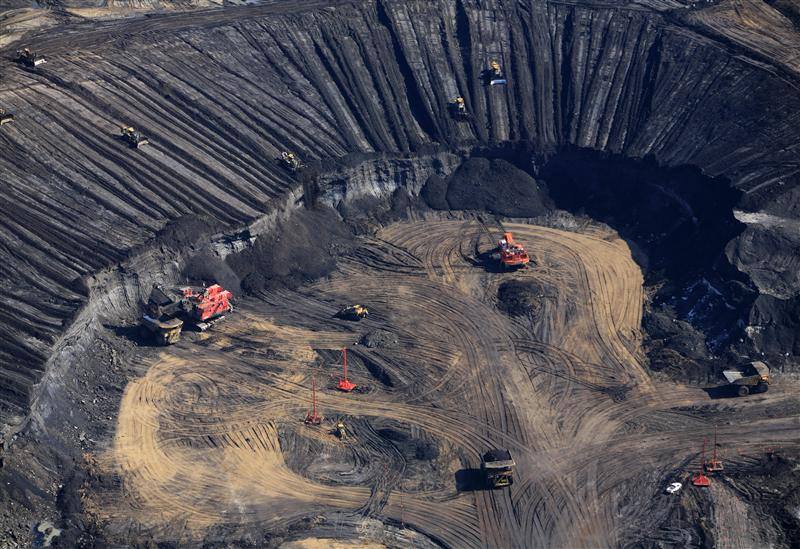
Syncrude Aurora tar sands mine in the Boreal Forest, Canada. Image Source: Greenpeace / Jiri Rezac http://bit.ly/MOOWmP
But the most pressing problem may not be the lack of sufficient and effective policies that support sustainable development and economy – it may be that policymakers are not educated to take climate change seriously. Take for example the U.S. House Committee on Science, Space, and Technology – which is, unbelievably, run by Congressmen unaware of the idea that melting ice causes an increase in water levels. Beyond uneducated leadership, almost half of all Americans do not believe that climate change is scientifically deemed as manmade – an idea that is exemplified by its coverage in the media. Many policymakers are also afraid that the shift to higher environmental standards and clean-energy innovation might have negative impacts on the economy.
Given this lapse in a basic understanding of science and the poor image that sustainable development has in the eyes of the media, global leaders must take a twofold approach to fighting climate change: first, a foundational approach involving educating the public on climate change through non-traditional media such as social and electronic media, given the bias of the traditional media. However, this education should also include pushing for textbooks and school curricula to include education on climate change, and requiring environment and energy policymakers to have a basic understanding of the science behind climate change before being allowed to legislate on climate policy. Additionally, the idea that climate change is a “debate” rather than a scientific fact needs to be combated through a more solutions-oriented approach to fighting climate change, rather than encouraging scientists and policymakers to add fuel to the fire of the idea that the process of climate change is something that is up for debate. Finally, sustainable development needs to be advertised as being economically sustainable and advantageous. Given the massive economic potential of clean energy and green products, and the long-term economic potential of investing in research on the environment, scientific institutions and policymakers alike need to advertise the profitability of such ventures.

Climate Education Protest. Image Source: Tck Tck Tck / http://bit.ly/1vHuHWM
Second, a more top-down policy approach needs to be implemented. While the foundational approach is well suited to the long term, it has minimal impact in the short term. Policymakers need to have the incentive to make clean energy the emphasis of their energy policy, so that they can make a long term shift to cleaner energy. This requires the strengthening of the pro-environmental groups and clean energy company lobby, which should have a vested interest in developing clean energy infrastructure, such as developing a network of electric car charging stations. It also requires more subsidies towards scientific research in clean energy and technology, away from traditional petroleum lobbies and products. While this solution may exacerbate the current dysfunctional heavily lobbied political system of most developed countries, a short term solution is better than an unworkable solution that tries to push for a more ideal political system without making a lasting impact on climate policy.
In addition to private companies developing a stronger lobby, policymakers need to encourage the investment into clean energy technology. This can assist in improving the profitability and market attractiveness of the clean energy sector in the short term, and in the long term improve the energy independence of countries. Finally, governments need to set stricter standards on emissions, and reward companies that are adhering to those standards, not through the traditional and inefficient cap-and-trade system, but through direct subsidies. If governments are able to advertise such policies to companies which have already invested in environmentally friendly standards and technologies, then such policies have stronger backing, and can push away oppositional lobbies.
The world faces major challenges in the battle against climate change. Both the short and long term positive changes will be achieved once we stop misrepresenting the facts of climate change, and begin to emphasize the reality of its nature, and how it affects us.
About the Author





