
The title of this article is not accurate, in order for something to return then it needs to leave first. The Egyptian Military never truly left the Egyptian political scene. In a previous article I argued that President Morsi has failed to end the role of the Military and that the re-shuffle of the top brass was done with the consent of the Egyptian army. I argued that the Muslim Brotherhood reached an accommodation with the Military, allowing it to maintain its extensive economic empire and influence over crucial areas of policy, particularly foreign policy. I also argued that unless President Morsi builds a broad coalition with secular political forces and manages to pacify social unrest, it is a matter of time until the army intervenes. My predictions have unfortunately proven true.
Morsi was his own worst enemy. The Muslim Brotherhood inherited an apparatus of power from the Mubarak regime and believed that it can rule in the same manner, wielding it as it saw fit to serve its own narrow interests. Besides gross incompetence in running the affairs of the state, Morsi relied heavily on force to pass a constitution that was opposed by a critically important minority, namely the urban middle class, concentrated in Cairo and Alexandria. The Muslim Brotherhood adopted a narrow idea of democracy, a fallacy that one can refers to as “electoriasm”. The Muslim Brotherhood truncated democracy into elections, ignoring the necessity of democratic institutions and the need to eliminated autonomous power centers that are beyond the reach of the elected government, namely the military. Morsi failed to understand that there are social classes that have significant political clout, a clout that exceeds their number, namely the urban middle class. When Morsi failed to gain their support – actively antagonizing it at some point – it was only a matter of time before the military intervened. However, Morsi’s worst mistake was the accommodation that he reached with the army. This accommodation allowed the Military to extensively whitewash its image and to return as the people’s savior from the oppressive rule of the Muslim Brotherhood. The failure of the Muslim Brotherhood in Egypt has damaged the brand of political Islam. The extent of the damage and its regional implications are difficult to assess at this point.
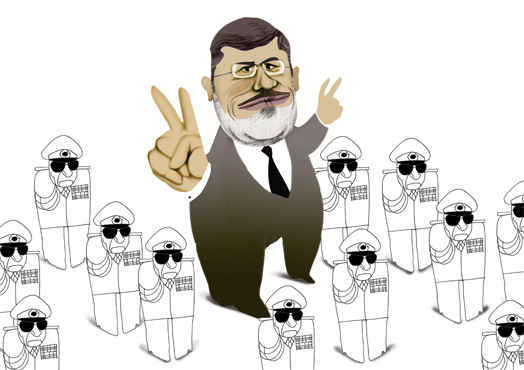
Morsi and the Egyptian Military. Cartoon by Mohammad Ali Ziaei
The return of the Military to rule Egypt, albeit under a thin veil of civilian government will have dire consequences. The price for the removal of Morsi is much steeper than many Egyptians think. The first consequence is the cooption of the secular, liberal opposition by the army. The opposition has been coopted as many of its leaders are actively support the military. This has dire consequences for the future of the Egyptian revolution and its goals. In order for the revolution to achieve its goals, deep structural changes need to be introduced into the economy. Changes that involve dismantling the Egyptian Military’s economic empire. In other words, wide re-distribution of wealth and economic resources from the elite military caste and their crony capitalist allies to the middle and lower classes. This naturally involves a confrontation between the military and the revolutionary forces. With the opposition decapitated, this confrontation becomes more difficult. The revolutionary movements was already suffering from lack of coherence and leadership, with the recent cooption of its possible leaders this trend becomes even more serious and alarming. The opposition is discrediting itself without realizing it. Second, comes the success of the military to white-wash its image as the protector of the people. This image was heavily tarnished after the first transition period where the military was involved in a number of massacres against protestors.
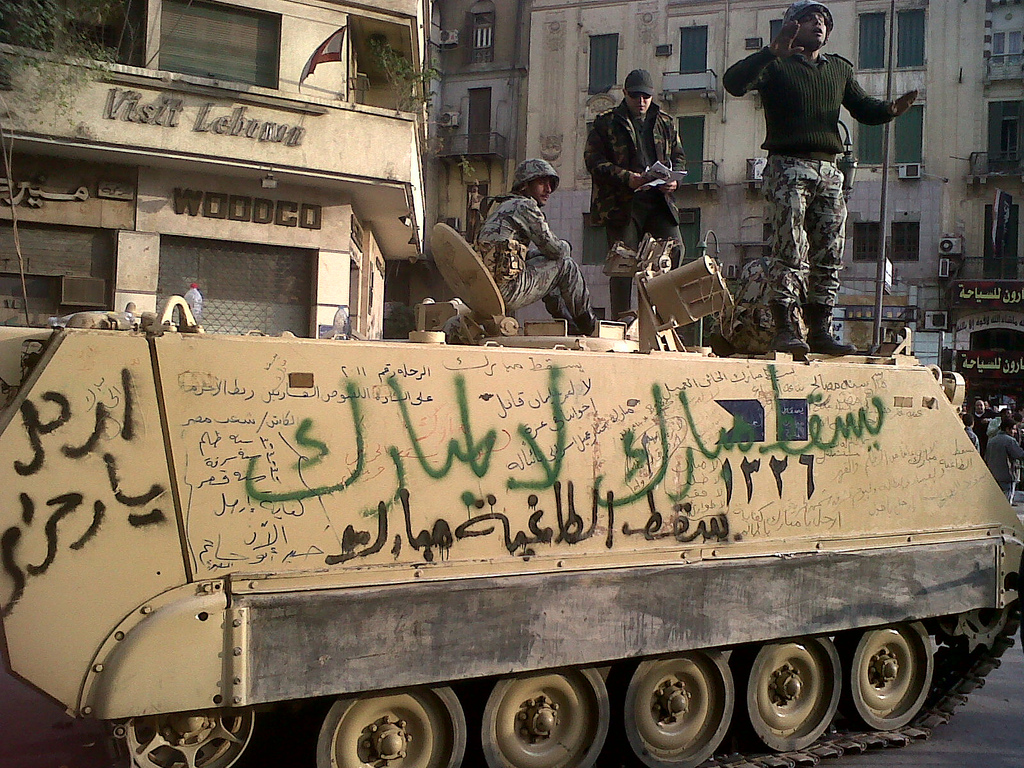
The army played a significant role in the removal of Mubarak in 2011. Image Credit Monasosh/Flickr
The success of the military re-branding effort has weakened the revolutionary movement. If the military has indeed learned from the mistakes of the first transitional period then it will not attempt to govern directly, and it will avoid a direct confrontation with the revolutionary movement. This strategy will make it much more difficult for the revolution to gain traction in the right direction and confront its main opponents. The military is the biggest winner! Finally is the trend of violent confrontation and possible exclusion of the Muslim Brotherhood from the political process, a trend that can prove disastrous for Egyptian stability. The Muslim Brotherhood has a solid social foundation, and it is very difficult to uproot it without considerable violence. If violence escalates the Muslim Brotherhood might decentralize and the current political leadership might be swept aside by more radical elements which in turn might plunge the country into long-term civil strife. An accommodation needs to be reached quickly between all parties otherwise Egypt risks significant violent upheaval.
About the Author





