
Strolling along the pedestrian esplanade of Beirut’s Zaitunay Bay on a Sunday afternoon is an eye opening experience: extravagant yachts line the harbour, restaurants, bistros and cafes hum with activity, and the clientele of wealthy Lebanese urbanites take in the gentle sea breeze that blows in off the Mediterranean. Following the end of the long and bloody Lebanese civil war in 1990, vast swathes of the destroyed city were redeveloped as part of an ostentatious project to reclaim Beirut’s once held title as ‘jewel of the Middle East’. The new souks lie at the heart of this downtown regeneration programme, and it is here that customers can choose between Giorgio Armani and Louis Vuitton, Stella McCartney and Jimmy Choo. In a short space of time Beirut has been transformed, quickly re-establishing itself as a thriving destination for the Middle East’s rich and famous, providing a haven for pseudo-liberal values and a playground to be explored by the wealthy Saudi community.
Exactly one week later I was tucked up on the back seat of a minibus heading for Lebanon’s second city, Tripoli. The highway north of Beirut follows the contours of the coastline, passing through the ancient cities of Byblos and Batroun before descending upon Tripoli in a journey that takes just under two hours. The bus stopped only once on the outskirts of the city, for a vehicle search at a military checkpoint. Security here has been tightened in light of the ongoing civil war in neighbouring Syria, which has begun to frequently spillover onto Lebanese soil.

Beirut at the end of the civil war. Image credit: Luciana.Luciana
Tripoli has been unable to grasp the investment opportunities seized upon by Beirut. The glass façade buildings, so often an indicator of modernity and 21st century prosperity are nonexistent in Tripoli. The centre of the city is functioning but dilapidated. The souks are bustling but decaying. Hollow buildings from the war remain, despite Tripoli suffering only modest damage in comparison to the near-annihilation of Beirut. The streets are alive but the economy is dead; unemployment is high and over half of the population live on less than $4 a day. Fighting between the adjoining Alawite and Sunni neighbourhoods continues to cast a dark shadow over the city, leaving the local economy in a state of perpetual paralysis.
So how, following the end of the civil war some 23 years ago, have the trajectories of Lebanon’s two largest cities been allowed to veer off into such opposing directions? The political and economic elite in Lebanon has long been interested in directing and spinning Beirut’s ‘success story’ for personal gain. A key component of this strategy has been the establishment of a centralised economy, where Beirut is Lebanon. As a result, Tripoli, with a population of half a million, has been financially neglected for over 20 years. Portrayed as a war zone in the international media, the city has gained a reputation as a breeding ground for religious extremism and a proxy-war battleground for warring militias in the Syrian conflict. This portrayal is grossly unjust. The city is archaic, a mishmash of high vaulted souks and intricate alleyways that provide a sense of its once held grandeur. Sweets are the delicacy here, and dotted around the city you’ll find places selling the finest mafroukeh, baklava and namoura of anywhere in the Middle East.
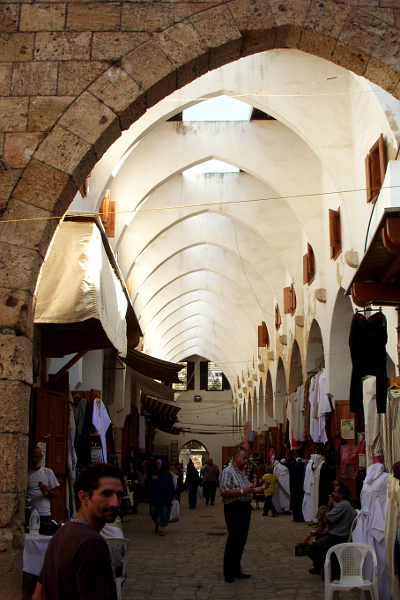
The Tripoli souks are the closest you get to real souks in Lebanon. Image credit: Arnaud DG
But for all its character and charm, the city is crying out for investment. Fighting persists in Tripoli partly due to high unemployment rates amongst young men. Joining a militia comes with attractive perks when you’re living below the poverty line: the promise of money, food and increased social capital. Lebanon’s only international airport is located in Beirut, but Tripoli also has an airport with the potential capacity to handle international flights. The power structures in Beirut are reluctant to transfer any resources away from the capital as such a move would see a direct transfer of revenue away from the lucrative Beirut monopoly over the movement of goods and services entering and leaving Lebanon.
Igniting the economy is of primary importance to the majority of residents. Prospective projects continue to stall before they can be finalised, as was the case in a proposal tabled earlier this year to reclaim Tripoli’s sea front area by building homes, hotels and a marina in a project covering 1 million square metres at an initial cost of $100 million. Tripoli needs inward investment to curtail the high levels of unemployment and to provide its residents with viable alternatives to the culture of conflict and drug trafficking that currently prevails within its neighbourhoods.
An often-discussed issue in Tripoli is that Lebanon’s pillars of power are only interested in the city when they need something, usually election votes. In the eyes and minds of many key stakeholders in Beirut, Tripoli is separate from Lebanon in all but geographical terms. It’s a counter-productive business mentality, since the international community and potential inward investors rarely make that same distinction. With the entire region currently gripped by political instability and social upheaval, inequalities in Lebanon are likely to be exacerbated further before they improve. It looks like development in Tripoli will have to wait a little longer.
About the Author





