
Though the UN Climate Summit last week brought no major agreements in the fight against climate change, it was widely considered a success. The summit was called together to inspire the world’s leaders to reflect upon their countries’ emission reduction targets due by 2020, before the initial talks in 2015. The event itself consisted of 4 minute speeches by each of the more than hundred heads of states and resulted in a number of remarkable outcomes:
- Public awareness
The talks may have taken place on Tuesday but history was written two days before: hundreds of thousands of people marched the streets all across the globe to demand climate action, and their call did not remain unanswered: acknowledging the protest President Obama said on Tuesday:
“We cannot pretend we do not hear them. We have to answer the call.”
The number of protesters surprised even the organisers and proved to have very serious power in influencing corporate and political involvement in the fight against climate change.
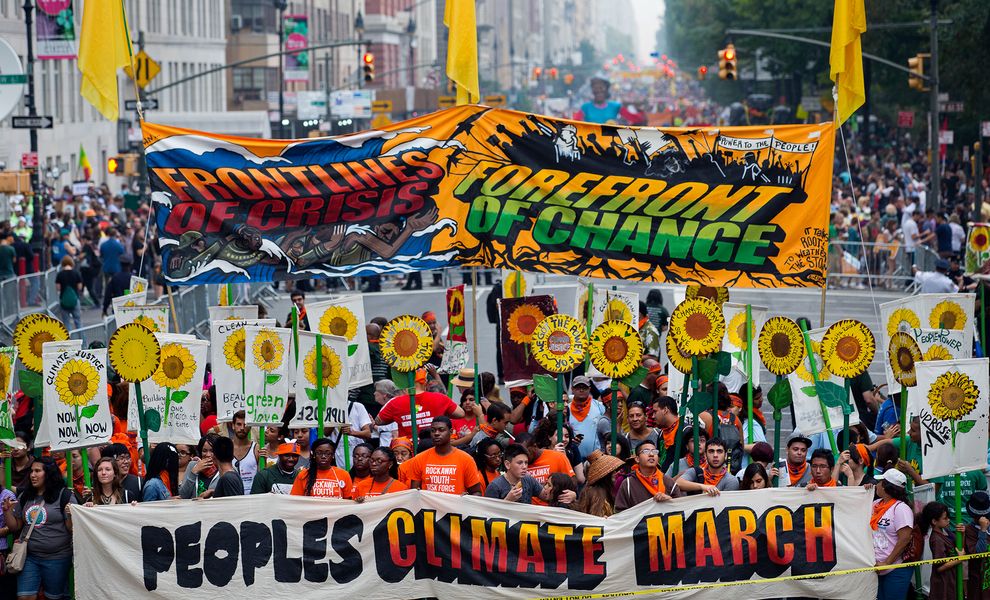
People’s Climate March. Image Credit: BBC
- Greater corporate involvement
More than 40 large companies pledged to halt deforestation including Kellogg’s, Nestlé, Johnson & Johnson, Procter & Gamble and Walmart. Carbon dioxide is stored by forests and deforestation is one of the main factors contributing to global warming. The companies, together with 32 countries, pledged to work towards stopping the process by 2030. Critical voices deemed the pledge a mere PR stunt, but the real power lies in the hands of the public as companies are slowly responding to their customer’s needs for eco-friendly corporate practices.
- Grander political involvement
There has been little progress since the initial climate talks in Copenhagen in 2009. According to a recent document by the Global Carbon Project, global carbon emissions at the current rate will create a 5C warming by the year 2100, resulting in devastating consequences. Therefore, it is crucial that the current heads of states produce viable plans in the next 6 months to reduce emissions so that agreements can be made in next year’s climate talks. Most representatives were not in office during the conference in Copenhagen therefore the Summit provided a great opportunity to refresh the issue and restart conversations.
- Increased participation of great polluters
China, one of the largest polluters on Earth, pledged to issue a document as soon as possible on when the country will reach its pollution peak. China’s Vice Premier Zhang Gaoli announced on Tuesday. In the light of the scientific fact that consequences of climate change will be unstoppable if not halted by 2025, China’s involvement is a huge step forward. Such a document offers some hope that the country will participate in the 2015 talks with a serious plan in mind.
- Green Climate Fund
Five years ago, “developed” countries pledged to take responsibility for creating global warming by burning fossil fuels and took responsibility for the risks posed upon poorer countries. Thus, a fund was created to promote cleaner energy production by developing countries to mitigate climate change. Germany thus far offered $1 billion while France, South Korea, Denmark, Norway, Mexico, Luxembourg and Indonesia also donated to the fund. This year’s talks provided a great opportunity to refresh the cause and motivate developed countries to donate. Though successful, the summit did not elude controversy: the UN Pension Fund, a combined fund of the retirement savings of all UN employees reportedly has a $53 billion investment in fossil fuels itself, drawing criticism from commentators who argue that the UN`s funds should be where its mouth is. UN Secretary-General, Ban Ki-moon’s objective to create a competition among world leaders to ambitiously tackle climate change encouraged some promising developments but, whether climate talks will result in further action will depend on next year’s talks in Paris. The success of the Summit gives hope that talks will result in action, and that real progress will take place before it is too late.
About the Author





