
A few weeks ago, the Chancellor of the Exchequer, George Osborne, took the opportunity to publicly congratulate himself. Real GDP growth in the first quarter of 2013 was 0.3%, alleviating concerns of a triple-dip recession. Even better, second quarter growth reached 0.7%. Referring to the Government’s economic plan, whose approach to economic recovery centred around the introduction and persistence of tough austerity measures, Osborne declared “we held our nerve when many told us to abandon our plan…the last few months have decisively ended this controversy”. There are two claims embedded in this statement. One is that many sources opposed his economic measures. The other is that they have been proved wrong. Regarding the latter he is deeply mistaken. GDP is not the only measure of economic success. The level of those living in unacceptable conditions is key, and it is a fact that the worst-off have suffered badly under austerity. No economic plan can be considered a success in light of such an outcome.
Opposition to the government’s economic plan
There is no doubt regarding Osborne’s first claim: that his plans have faced strong opposition. In 2011, 500,000 people took to the streets to protest against the austerity plans. More recently, a ComRes survey for the Independent found that 58% of the public believe the Government’s economic plan has failed – interestingly, this poll was conducted after the real GDP growth of the first quarter of 2013. Organisations have also voiced their opposition to the austerity measures. The New Economics Foundation (NEF) published a damning report in early 2013 attacking the Chancellor’s plans, in which they claimed that the argument for pursuing austerity was “arguably the single worst economic argument that any British government has even been taken in by, let alone enacted into policy”. Even the IMF, proponents of austerity measures across the EU, announced in May that they felt Osborne’s austerity measures were going too far, and would inflict long-term damage to the UK’s economic growth prospects.

Ant-austerity demonstrators march up Whitehall in London on 26 March 2011. Image credit: celesteh
Compelling reasons for opposing austerity are not hard to come by. When a country is in the grips of a recession, the government must find a way to stimulate the economy, otherwise the economy faces a negative multiplier effect. Households spend less, which means that less is produced in order to meet decreased demand. Producing less requires less work, and as a result wages are pushed down and/or unemployment goes up, which causes households to spend less still, and the cycle continues. The Keynesian approach of boosting Government spending is one clear way of getting out of this downward spiral and boosting the economy. Well-targeted government spending leads to citizens having more disposable income. They spend more and the recipients of this extra spending will in turn have more and will spend more, resulting in a positive multiplier effect. (On the contrary, one would expect a reduction in government spending to do the opposite. 490,000 public sector jobs have been cut as a result of the coalition’s economic plan. These people spend less as they have lower disposable incomes, and consequentially less is produced in order to meet reduced demand. All else equal, one would expect a downward multiplier effect to take place.)
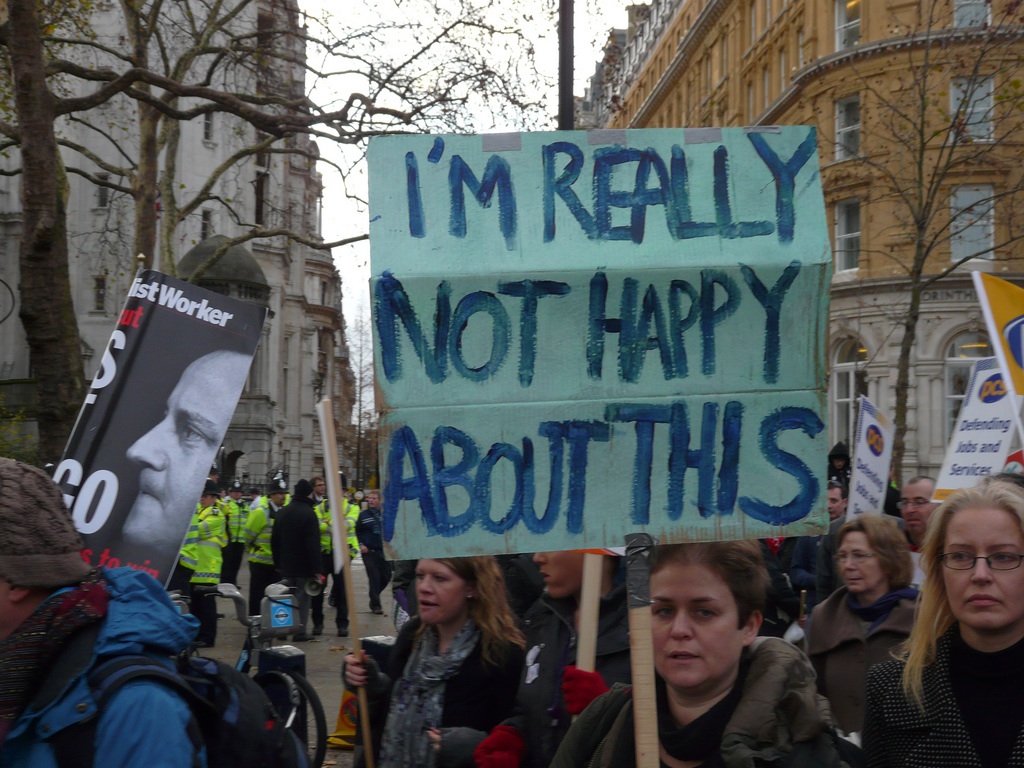
N30 Public Sector Demonstration. Image credit: Loz Pycock
Apparent success
In light of huge cuts to government spending, the government had to find alternative ways of boosting the economy. Two routes were pursued. One was through increased private investment. The other was through an increase in net exports. The hope was that these two would compensate for the reduction in government spending, whilst simultaneously reducing the budget deficit.
In view of the recent GDP growth, Osbourne is claiming his economic strategy has been successful. On the GDP front it is not so clear that he is right: a different strategy may well have resulted in a quicker and stronger recovery, and the risk of another housing bubble indicates that the recovery is unstable. However, I would like to set these issues aside to focus on a more serious problem.
GDP growth at the cost of increased poverty is no success
Osborne’s focus on GDP is highly superficial; there are several indicators of a successful economic policy, not just GDP. GDP growth can be very imbalanced; the rich may benefit, whilst the poor lose out. This point is crucial. Suppose that those on the lowest incomes are dealt a blow to their fortunes whilst overall there is GDP growth. Is this an acceptable situation? If those on the lowest incomes are still able to afford a decent standard of living, then there is a reasonable (though by no means conclusive) case for sacrificing their incomes in order to promote overall economic growth. On the other hand, if they are unable to maintain a decent standard of living, such action is morally unacceptable. This is not a radical assertion. We all recognise that the growth of a company should not be praised if it involves sufficiently poor working conditions. Likewise, overall GDP growth is nothing to boast about when it involves taking away a decent standard of living for increasing numbers of people.
It is notoriously difficult to define what a ‘decent standard of living’ is, however certain indicators make it intuitively clear that the poorest in our society have had to sacrifice such a quality of life. Firstly, there has been a growing inability to buy food. Over the summer months, there has been a 78% increase in people accessing food aid, including food banks. According to the polls, one in five parents has had to skip meals or ask for food donations so that their children could eat. Secondly, there has been a 23% rise in homelessness in the past two years, with over 10,000 extra people being made homelessness. A further government report showing that those sleeping rough have increased by almost a third between 2010 and 2012. Thirdly, those earning below the ‘living wage’, as calculated by the Rowntree Foundation, has increased by over 1.4 million since 2009. Since the coalition has entered government, an extra 1 million people are living in poverty (as defined for the UK). This is nothing to be proud about. Each of these numbers represents real people, people who instead of spending their afternoon writing articles like this are queuing up at the food bank, struggling for their next meal.
A successful economic policy does not sacrifice segments of the population in this way. Eliminating homelessness and poverty altogether is difficult, especially in the midst of a deep recession and a severe financial crisis. However, causing the numbers to flourish as part of a recovery strategy represents a lack of empathy towards those sacrificed in the process. The government has cut benefits, cut legal aid, imposed housing taxes (including the bedroom tax) that mainly target the poor, and the National Minimum Wage has totally failed to keep up with inflation. This contradicts our imperative as a nation to ensure that our poorest members are able to maintain decent living conditions.
Was this avoidable?
The counter-argument that the government lacked the funds to support the poorest is baseless. Firstly, more could have been borrowed to support those in poverty. The rationale behind austerity was that increased spending would place the economy under such a large level of debt that it would severely damage recovery. This thought is derived from an influential paper by by two scholars, Reinhart and Rogoff, who showed that when debt is above 90% of GDP, growth declines. As Nobel Prize-winner Paul Krugman points out, this conclusion was mistakenly inferred by policy makers to mean that when debt exceeds 90% of GDP, growth sharply declines. This is a very different claim, and one that is unsubstantiated. More could have been borrowed in order to alleviate the poorest from suffering hardship, without serious consequences.
Secondly, those unable to maintain a decent standard of living must be given priority over the more wealthy segments of the population in any spending that does take place. If they had been given such priority, the suffering we currently witness in our society would not be so prevalent. Instead the government did the opposite. Following a barrage of spending cuts, the government reduced the top rate of tax from 50% to 45%. Following the infamous ‘bedroom tax’, the government refused to put in place a ‘mansion tax’.
George Osborne has implemented a highly unsuccessful economic policy. To see this, one does not need to argue that a different approach would have boosted GDP earlier, or by a greater amount. One merely needs to realise that there has been a sharp increase in those living in unacceptable conditions, and that this was avoidable. A change in economic priorities is needed; future economic plans must regard the number living in such conditions as a key measure of success, and certainly not trade-off overall growth for an increase in their number. Often such a trade-off is not required. Indeed in this case a more Keynesian approach towards the recovery would have delivered growth, whilst avoiding this increase in poverty.
About the Author





